💡 Affiliate Disclosure: PetchCrea is reader-supported. When you buy through links on our site, we may earn an affiliate commission at no additional cost to you. As an Amazon Associate, I earn from qualifying purchases. We only recommend products that genuinely help you optimize and organize your space.
If your bedroom lacks the square footage for a traditional nightstand, practical bedside storage relies on three underused zones: the vertical wall surface right beside your mattress, the narrow structural gap along the bed frame, and the perimeter of the headboard itself. You do not need dedicated floor space to keep bedtime essentials like a phone, water glass, reading glasses, and books within comfortable reach. Selecting the right setup comes down to how much physical weight you need to support and whether your living arrangement permits drilling into the walls.
This guide addresses tight bedroom configurations common in urban apartments, shared rentals, dorm rooms, and converted attic spaces where standard 18-to-24-inch bedside tables block closet doors, obstruct walking paths, or simply cannot fit.
Key Takeaways: Selecting Your Setup
- If you have zero floor clearance: Bedside caddies, clip-on frame trays, or wall-mounted ledges preserve walking paths completely.
- If you have a narrow gap (5 to 10 inches): Slim rolling utility carts or tiered gap towers provide vertical storage without protruding into doorway zones.
- If you are renting with strict lease terms: Frame-clamped trays, hanging felt pockets, and heavy-duty tension rod shelves require no wall anchors or screw holes.
- If your room doubles as a workstation: Multi-tiered organizing systems keep daily chargers, stationery, and devices separated from your resting zone.
Start by Identifying Your Setup
Before purchasing any organizers or mounting hardware, assess your bed’s physical boundary conditions and room layout:
- Rental vs. Owned Property: Renters often face restrictions against drilling into drywall, making friction-mounted, frame-clamped, or hanging fabric systems necessary. Homeowners have the freedom to mount heavy-duty floating cubbies or wall-anchored swing-arm fixtures directly into wall studs.
- Bed Frame Style: Platform beds with exposed side rails accommodate clip-on shelves and clamp trays. In contrast, divan bases, upholstered box springs, or floor-level platform frames work best with hanging pockets that tuck firmly beneath the mattress.
- Door, Window, and Drawer Clearances: Placing a rigid unit too close to an adjoining wall can block closet doors, prevent under-bed storage drawers from sliding open, or interfere with low window sills and heating baseboards.
- Wall Construction and Stud Locations: Hollow drywall anchors support lightweight ledges for phones and eyeglasses, but heavy book stacks and ceramic drinkware require toggles or direct wood-stud anchoring.
- Electrical Outlet Proximity: Check where your nearest wall outlet sits relative to your headboard to prevent power cables from dangling across walkways or becoming pinched behind moving frame components.
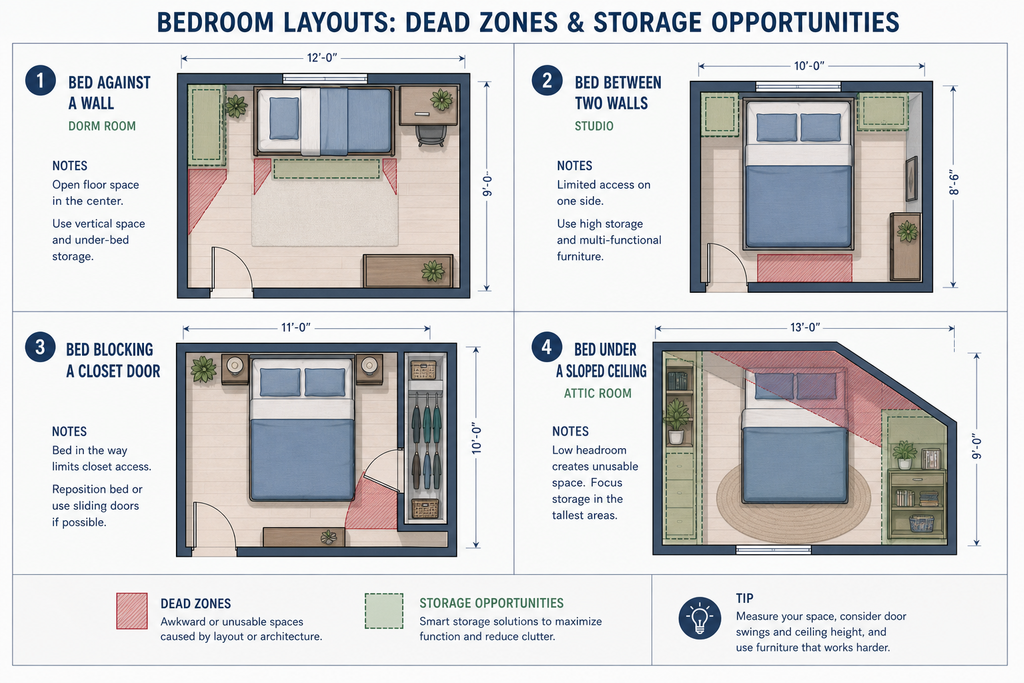
Measure Before You Buy: The Bedside Clearance Checklist
Take these specific physical measurements using a standard tape measure before selecting a storage system:
- Horizontal Bedside Clearance: Measure the physical distance between the outer edge of your mattress or bed frame and the nearest obstruction, such as a wall, closet door swing path, or radiator. Note whether this width changes when closet doors are swung fully open.
- Mattress-to-Floor Height: Measure from the floor to the top of your mattress surface. A comfortable bedside surface should sit within 2 to 3 inches of your sleeping height so you do not have to stretch downward awkwardly in the dark.
- Bed Rail Dimensions: For clamp-on trays, measure the exact thickness and depth of the exposed wooden or metal side rail. Most consumer bed clamps support rail thicknesses between 0.5 inches and 1.75 inches, so verify your frame falls within that range.
- Vertical Headboard Wall Clearance: If mounting shelves above or beside the pillow area, measure the height from the mattress top to the lowest edge of any wall decor, sconces, or windows. Leave at least 18 to 24 inches of clearance above the pillow line to prevent accidental head impacts when sitting up.
- Cable Reach: Measure the linear distance from your bedside resting position to the nearest wall receptacle to determine whether you need a longer cable or an organized management strip.
Choose the Right Solution for Your Setup
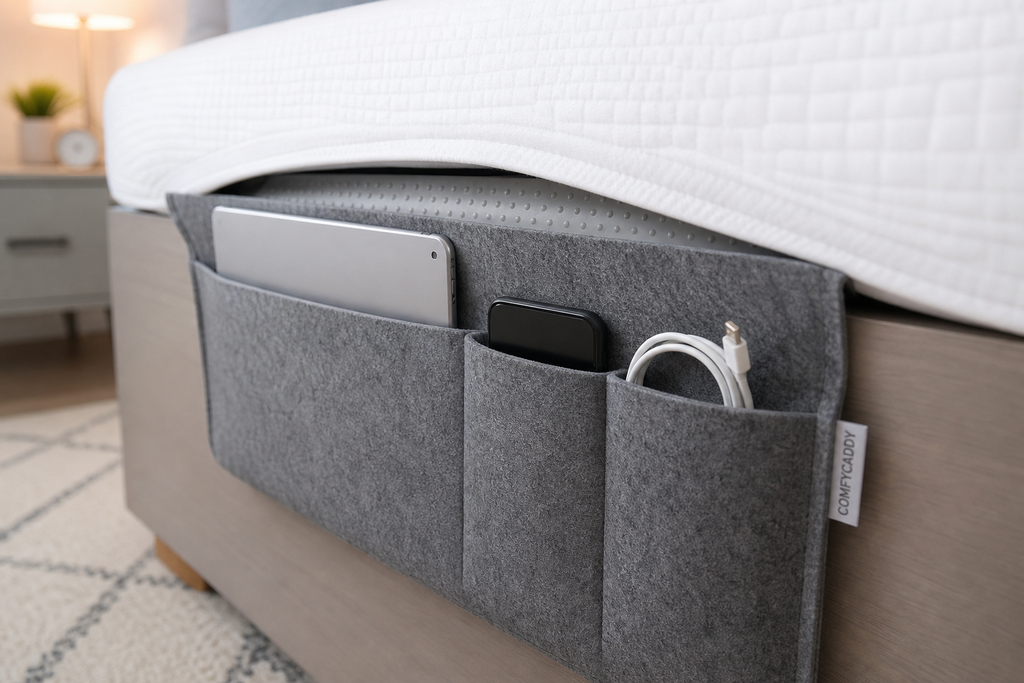
1. The Bedside Pocket Caddy (Tuck-In Frame Organizer)
The Problem It Solves: Keeps daily bedside essentials accessible when you have absolutely zero floor clearance beside the bed and cannot mount anything to the wall.
When It Is a Good Fit: Highly compact rental bedrooms, dorm rooms, and platform beds where the mattress rests directly against a drywall partition. It holds flat, lightweight goods such as reading tablets, smartphones, eyeglasses, journals, and charging cords.
What to Measure and Check:
- Verify your mattress has enough downward weight to anchor the insertion flap securely. Lightweight foam mattresses on slick slatted bases may allow the caddy to slip outward under load.
- Measure the drop length from the mattress base to the floor. The hanging pocket should not drag on carpet or block under-bed vacuum paths.
- Check the structural firmness of the backboard flap. Look for designs reinforced with rigid composite boards rather than thin unsupported felt.
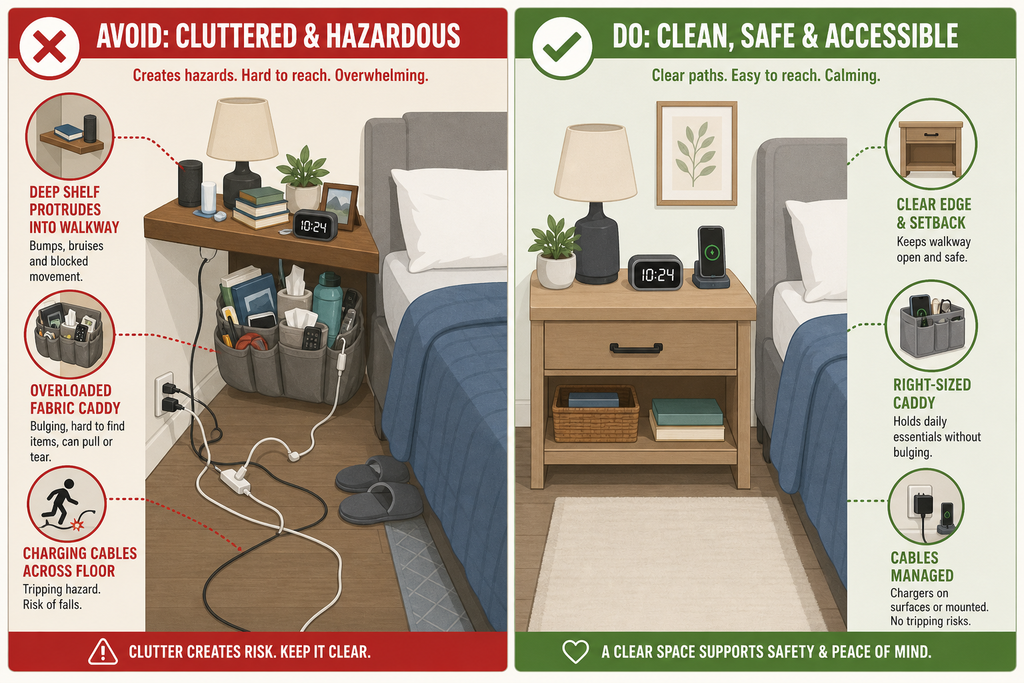
Limitations and Common Mistakes: Fabric caddies cannot safely support open liquids or heavy ceramic mugs. Overloading front pockets with bulky hardcovers causes the organizer to bulge outward into your walking space.
Setup Tip: Place a non-slip silicone mat beneath the mattress insertion flap to prevent lateral shifting when pulling devices out of deep compartments.
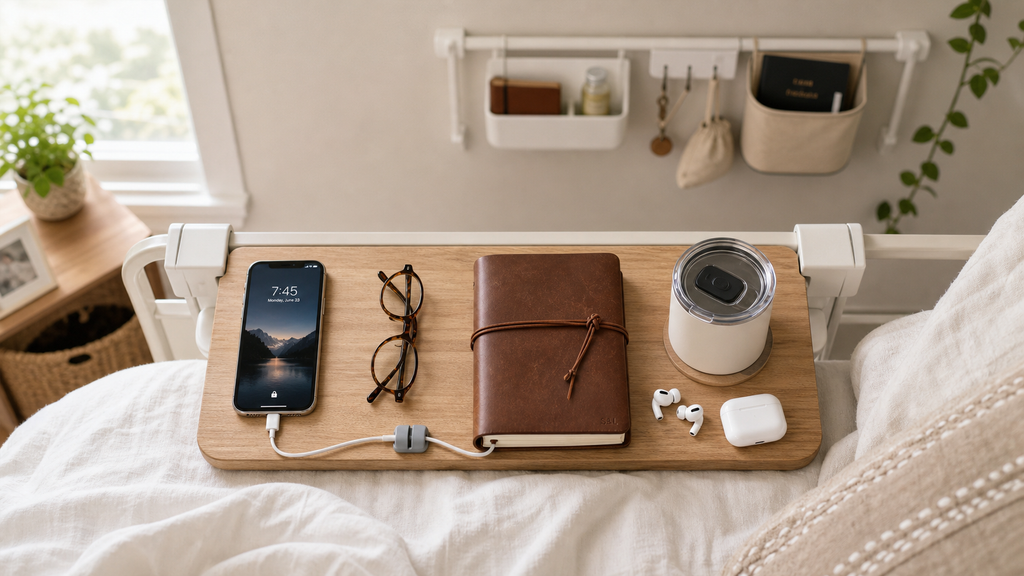
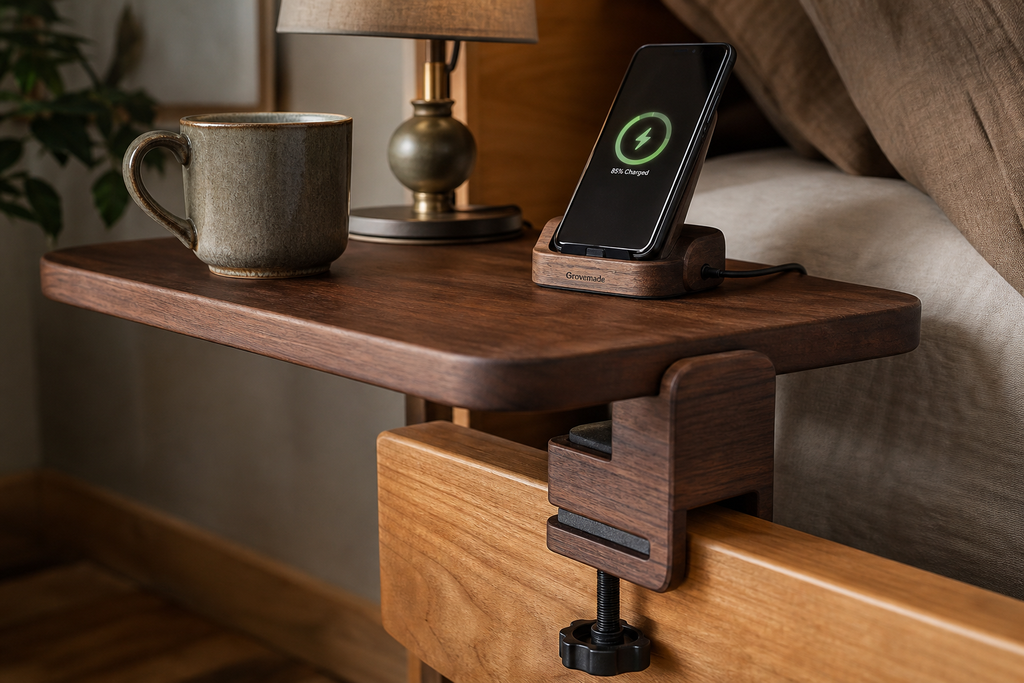
2. Clamp-On Bedside Floating Shelves
The Problem It Solves: Replaces a flat table surface without taking up a single square inch of floor area.
When It Is a Good Fit: Beds with exposed wooden or metal side rails, particularly loft beds, bunk beds, and minimalist wooden platform frames. It easily supports a charging dock, a reading light, and a secured beverage.
What to Measure and Check:
- Confirm the perimeter frame rail is exposed and not completely boxed in by an upholstered lip or inset mattress lip.
- Check the clamp grip depth against your frame’s crossbar profile to ensure the screw clamps can achieve flush contact.
- Verify the maximum rated load capacity, which typically ranges from 10 to 25 pounds depending on clamp construction.
Limitations and Common Mistakes: If installed along the midsection of the bed rail, clamp shelves can snag bedding, sheets, or knees when getting in and out of bed.
Setup Tip: Install the clamp shelf as close to the headboard junction as possible to keep your entry and exit corridor completely unobstructed.
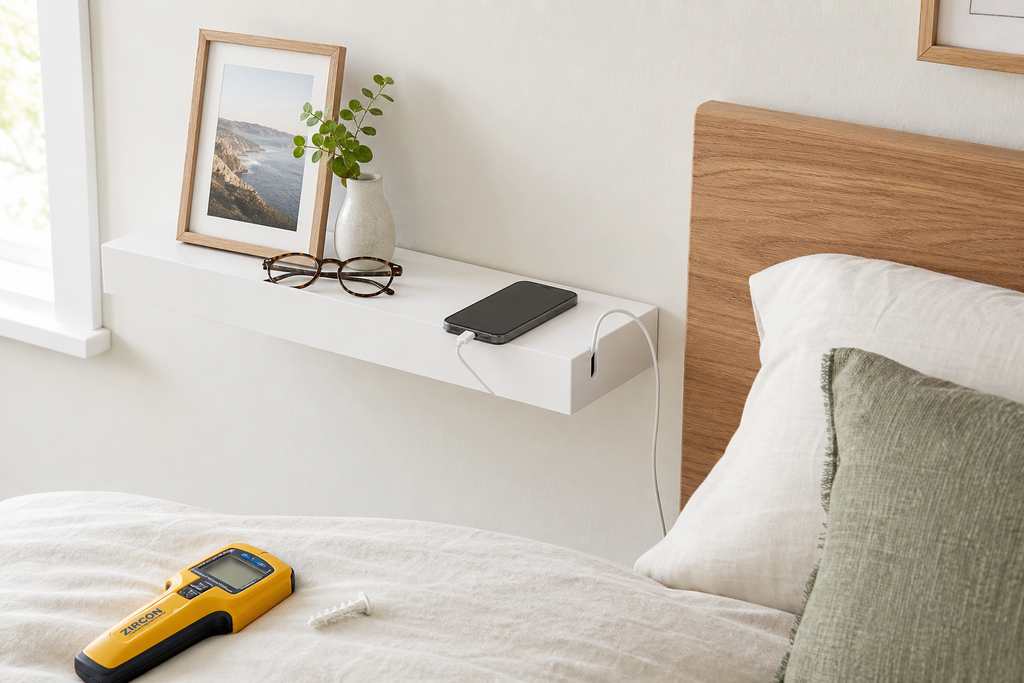
3. Shallow Floating Wall Ledges with Cable Grooves
The Problem It Solves: Creates an elevated resting perch for your personal belongings using open vertical wall space.
When It Is a Good Fit: Bedrooms where the bed sits parallel or adjacent to a solid drywall or plaster wall, allowing you to mount slim ledges (3 to 6 inches deep) directly beside the headboard.
What to Measure and Check:
- Measure wall anchor depth and use a stud finder to locate framing members.
- Calculate shelf protrusion into the room. Keep the total depth under 6 inches if mounted along a primary walking route to prevent bumped hips.
- Check that mounting positions sit well outside the arc of opening bedroom or closet doors.
Limitations and Common Mistakes: Anchoring deep floating shelves solely into hollow drywall using lightweight plastic expansion plugs often leads to sagging under minimal weight. For broader room organization advice, explore our comprehensive guide on small bedroom organization.
Setup Tip: Select picture-ledge styles with a front lip to prevent your phone, pens, or glasses from sliding off the edge when bumped in the night.
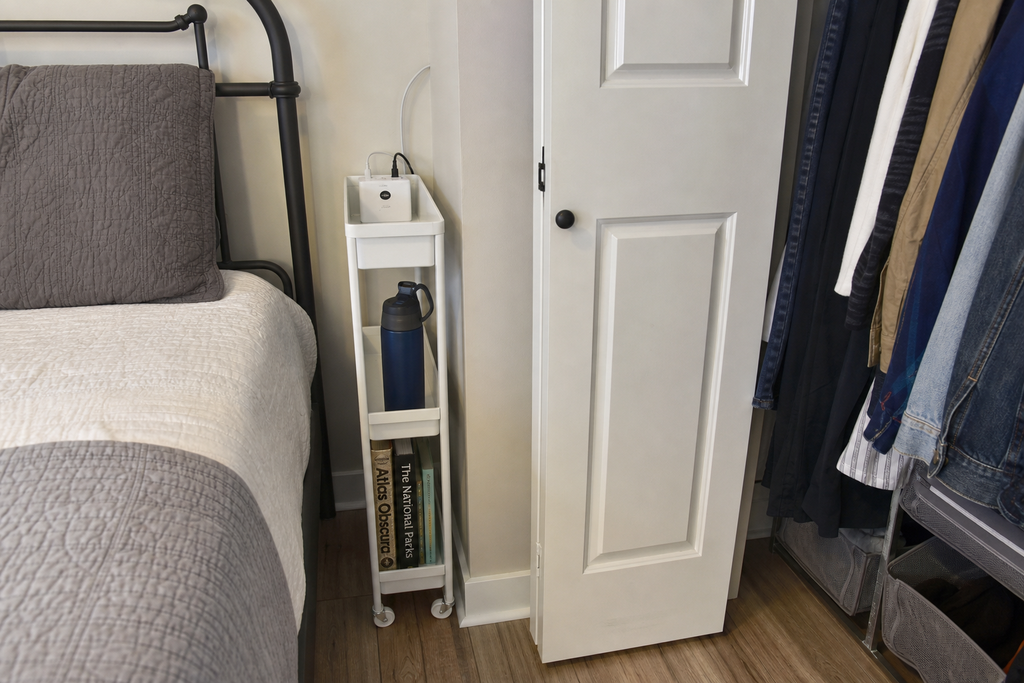
4. The Ultra-Slim Rolling Gap Cart (6 to 8 Inches Wide)
The Problem It Solves: Provides multiple tiers of concealed or semi-concealed storage in narrow spaces that would otherwise remain unusable dead zones.
When It Is a Good Fit: Bedrooms featuring a 6-to-10-inch gap between the outer bed frame and an adjoining closet, window frame, or wall.
What to Measure and Check:
- Measure the gap width at both the floor level (accounting for baseboards) and at mattress height to verify uniform clearance.
- Measure the height of your bed frame relative to the cart handles to ensure smooth pulling access.
- Check caster wheel clearance across your specific flooring surface, especially on medium-to-high pile carpets.
Limitations and Common Mistakes: Narrow-base utility carts have a higher center of gravity. Storing heavy items on top shelves while leaving bottom shelves empty can cause the cart to tip when pulled quickly across uneven surfaces.
Setup Tip: Place heavier items like books and backup hydration bottles on the bottom shelf, keeping charging hubs and loose personal items on the top tray for balanced stability.
5. Headboard-Mounted Vertical Organizer Rails
The Problem It Solves: Uses the structural back of the bed frame itself when neither the side walls nor side floors are accessible.
When It Is a Good Fit: Symmetrical bedroom layouts where the bed is tightly centered between two fixed structures, leaving no side clearance on either side.
What to Measure and Check:
- Measure headboard slat thickness or panel depth if using over-the-headboard hanging brackets.
- Ensure mounted components do not protrude forward into the pillow rest area.
- Check whether the headboard material can accept non-marring clamp fittings or non-damaging adhesive brackets without compromising the finish.
Limitations and Common Mistakes: Placing hanging storage directly above sleeping pillows introduces the risk of items falling onto your head if jostled during the night.
Setup Tip: Position organizing hooks, pockets, and rails on the outer vertical edges of the headboard wings rather than directly above your headrest area.
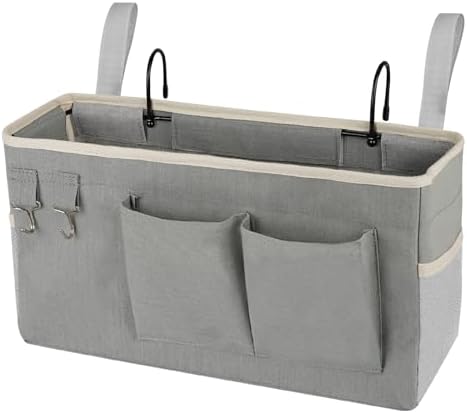
- 【Full-scale Encirclement】Unlike other similar bedside storage bag where only part of the iron frame is covered, the meta…
- 【Wide Usages & Space Saving】The bedside caddy organizer can store all of your belongings like books, remotes, magazines,…
- 【Quality Material】The dorm essentials bed caddy is made of canvas and iron, make it strong and sturdy. The bedside stora…
6. Multi-Tier Wall Sconces with Integrated Shelving
The Problem It Solves: Combines bedside illumination and utility staging into a single wall-mounted footprint, freeing up space by eliminating standalone lamp bases.
When It Is a Good Fit: Small bedrooms where standard bedside tables are overcrowded by lamps, charging bricks, and cables.
What to Measure and Check:
- Check proximity to the nearest electrical wall socket to route cords neatly down the wall surface. For practical cord-routing ideas that keep spaces tidy, review our walkthrough on desk cable management.
- Ensure the lighting fixture incorporates an accessible on/off switch directly on the base plate rather than an in-line cord toggle positioned behind the mattress.
- Verify wall anchor ratings for fixtures holding dynamic loads like personal items and drinks.

- [Small Floating Shelves] – Set of 4 small wall shelves with 2 types of installation: up or down, each small shelf size i…
- [Multiple Uses] – These small wall mounted shelves can be mounted in room, including the bathroom, kitchen, or bedroom, …
- [Discover More Space] – The small shelf with solid wood texture can be perfect for small accessories. Decorate your home…
Limitations and Common Mistakes: Hardwired units require electrical work, while plug-in models leave exposed cords that need rigid raceway tracking to maintain a clean aesthetic.
Setup Tip: Choose fixtures that include built-in low-profile USB ports on the underside of the shelf plate to consolidate power feeds.
7. Bed-Frame Suspended Wire Baskets
The Problem It Solves: Offers rigid, deep-capacity containment for larger essentials like extra blankets, heavy hardcovers, or slippers right along the lower frame perimeter.
When It Is a Good Fit: Minimalist metal frames or elevated wooden foundation setups that have open perimeter clearance beneath the mattress line.
What to Measure and Check:
- Measure frame rail thickness to ensure the basket’s hanging arms sit securely without wobbling.
- Measure vertical clearance from the underside of the side rail to the finished floor to prevent basket scraping.
- Check that the wire grid spacing is narrow enough to prevent small essentials like lip balm, stylus pens, or charging cords from slipping through.
Limitations and Common Mistakes: Exposed wire baskets collect dust quickly near carpet level and can look visually cluttered if filled with loose, disorganized items.
Setup Tip: Line the interior base of the wire basket with an acrylic sheet or felt insert to stabilize small accessories and catch dust.

- 【Effortless Installation】- Our fruit basket are a breeze to install. Simply wipe the wall clean before installation for …
- 【Space – Efficient Storage】- These wall basket can store anything you need. Whether stacked or used alone, they meet you…
- 【Organized Three – Compartment Design】- Made of high – quality, wear – resistant carbon steel, the fruit basket for kitc…
Comparison of Bedside Storage Solutions
| Solution Type | Best For | Clearance / Space Needed | Installation Level | Rental-Friendly? | Main Limitation |
|---|---|---|---|---|---|
| Bedside Pocket Caddy | Tablets, books, phones, glasses | 0 inches of floor space; mattress flap zone | No tools (tuck-in) | Yes (100% removable) | Cannot hold open liquid containers safely |
| Clamp-On Bedside Shelf | Drinks, phone docks, daily essentials | 0 inches of floor space; 1–2 in. frame rail | Hand tightened (no drill) | Yes | Requires exposed, non-recessed frame rail |
| Shallow Floating Ledge | Framed photos, devices, glasses | 3–6 inches horizontal wall depth | Light drilling & drywall anchors | Conditional (requires patching upon move-out) | Weight capacity limited by drywall anchors |
| Ultra-Slim Gap Cart | Heavy books, storage bins, water bottles | 6–10 inches floor gap beside bed | Simple wheel/frame assembly | Yes (freestanding) | Difficult to roll on thick carpet |
| Headboard Rail System | Small catch-alls, reading lamps, cords | 0 inches of floor space; frame attachment | Non-marring brackets or clamps | Yes | Protrusions may interfere with pillows if misaligned |
| Integrated Sconce Shelf | Reading lamp replacement + phone dock | 4–8 inches wall depth beside bed | Wall anchors & cable management | Conditional (requires wall fastening) | Permanent placement near electrical supply |
| Suspended Frame Basket | Bulky journals, slippers, spare blankets | 8–12 inches vertical under-rail drop | Hook-over installation | Yes | Gathers dust near floor; open visual clutter |
Common Bedside Storage Mistakes to Avoid
- Overestimating Drywall Anchor Strength: Never load books or heavy drinkware onto small floating shelves secured solely with basic ribbed plastic wall plugs. Always use toggle bolts or locate a structural wall stud.
- Ignoring Drawer and Door Swing Paths: A narrow bedside cart might fit when your wardrobe doors are closed, but it can completely block your access once you open them in the morning. Always test dynamic cabinet swings before settling on a permanent organizer location.
- Creating Tripping Hazards with Charging Wires: Running power cables across open walking paths between the mattress and wall sockets poses safety risks in darkened bedrooms. Secure your cords along the baseboard or the back edge of your bed frame.
- Selecting Deep Storage Units in Narrow Corridors: A shelf or box projecting more than 6 to 8 inches into a tight side aisle will cause bruised shins and snagged bedding. In spaces under 24 inches wide, prioritize vertical wall ledges or hanging pockets over horizontal tables.
- Treating Nightstand Substitutes Like Junk Drawers: Because compact alternatives feature smaller footprints, accumulating loose receipts, extra cables, and clutter quickly overloads them. Limit your bedside surface strictly to items you need during your evening and morning routines.
Step-by-Step Bedside Organization Plan
Follow this sequence to organize your bedside space effectively:
- Clear Your Current Bedside Area: Gather every item currently resting along your bed rail, windowsill, bedside floor, or headboard and lay it out on the mattress.
- Sort and Purge Essentials: Separate items into active bedside needs (phone, water, eyeglasses, current book, essential medication) and daytime items that belong in a wardrobe or desk drawer.
- Take Room Measurements: Measure your horizontal gap between bed and wall, verify your bed rail thickness, and confirm your mattress height against the floor line.
- Select One Primary System: Match your measurements and lease conditions to a single system from the comparison guide above rather than mixing multiple mismatched organizers in a tight space.
- Install and Route Power Connections: Secure your storage system, then route charging wires flush along the frame using low-profile cable clips so plugs remain accessible without dangling.
- Assign Fixed Positions: Place open drink containers on level, rigid surfaces; slide flat electronics into secure vertical pockets; and reserve top shelves for immediate bedtime items.

- Reusable cable ties are made from premium nylon adhesive materials can be environmentally used multiple times
- Versatile Multipurpose: This cable organizer can be use in wrap all of loose cords
- Many Use in home, office, garage, outdoor
Managing Dual-Purpose Bedside and Work Spaces
In compact studio apartments and micro-units, the perimeter of your bed often overlaps with a desk or work zone. When floor area must support both resting and daytime productivity, clear boundary division becomes essential:
If your workspace sits directly alongside your bed frame, you can streamline the entire wall run by reviewing smart space-saving workstation layouts in our review of small home office ideas. Coordinating the physical orientation of your desk surfaces with adjacent nightstand storage stops work materials from spilling into your rest area.
For rooms requiring precise furniture alignment along a single wall, explore practical positioning strategies in our breakdown of small home office ideas layout. Structuring functional zones along a common perimeter prevents drawers and rolling carts from obstructing your primary walk path.
If your bedside table also serves as a secondary laptop staging station or video viewing perch, balancing display height with surface footprint is critical. Check out our comparative breakdown on laptop stand vs monitor stand to select compact, ergonomic supports that keep work gear from encroaching on sleep essentials.
Frequently Asked Questions
How can I store a glass of water without a nightstand?
A clip-on bedside shelf with a recessed, routed cup holder groove provides the most stable surface for beverages when you lack a traditional nightstand. Never place open liquid containers in fabric pocket caddies or on narrow picture ledges lacking a front guard lip. If using a standard wall ledge, stick to sealed water bottles or travel tumblers with leak-proof lids to prevent nighttime spills.
Will a clamp-on bedside shelf damage my bed frame?
High-quality clamp shelves feature non-marring rubber, felt, or silicone padding along the inner contact faces of their mounting brackets. To protect soft woods or delicate painted frames, apply a thin scrap piece of felt or adhesive silicone buffering between the clamp jaws and the frame rail before tightening. Avoid overtightening the screw clamps on hollow composite or MDF frames, as concentrated pressure can crack the substrate.
What can I use if my bed is against the wall and has no rails?
When a mattress is pushed flush into a corner with no frame rails or floor clearance, use a heavy-duty felt pocket caddy tucked deep beneath the mattress core. You can also mount a shallow, front-lipped picture ledge along the adjoining wall 12 to 18 inches above the mattress plane. For rentals where wall holes are prohibited, use extra-large, non-damaging adhesive organizer bins designed for zero-residue removal on painted walls.
How much weight can a floating bedside shelf support?
Load capacity depends entirely on the mounting method and wall substrate rather than the shelf material itself. A shelf mounted into hollow drywall with standard plastic ribbed plugs typically holds only 5 to 10 pounds reliably before working loose over time. Anchoring your shelf directly into a wooden wall stud with 2-inch structural screws or using heavy-duty steel toggle bolts increases safe load capacity to 30 pounds or more.
How do I keep charging cables from falling behind the bed?
Attach weighted silicone cable collars, adhesive cord clips, or small magnetic cable anchors to the rear edge of your clamp shelf, floating ledge, or bed rail. Positioning an anchor within easy arm’s reach prevents charging tips from dropping to the floor when disconnected from your device, eliminating the need to pull the bed away from the wall to retrieve fallen plugs.
Practical Conclusion
Creating functional bedside storage in a small bedroom does not require sacrificing comfortable walkways or investing in bulky furniture. By assessing your room’s physical clearance, identifying structural attachment points along your bed frame, and selecting organizers tailored to your living situation, you can keep nighttime essentials organized and within arm’s reach. Choose one targeted system that aligns with your available space, secure your charging cables cleanly, and enjoy an organized, clutter-free resting environment.