Best Kitchen Tables for Small Spaces That Really Fit
This article contains affiliate links. If you purchase through these links, we may earn a small commission at no extra cost to you.
You pull out a chair, open the refrigerator, and somehow the two are now fighting for the same three inches of kitchen space. Sound familiar?
Finding the best Kitchen tables for small spaces can be surprisingly tricky because a table doesn’t just need to fit—it needs to leave enough room for people, chairs, cabinets, and all the other things that insist on existing in a small kitchen.
And honestly, the smallest table isn’t always the smartest choice. Sometimes you need extra seating, storage, or a surface that can disappear when dinner is over. That’s exactly why researching the Best Kitchen Tables for Small Spaces before you buy is so important.
There isn’t one perfect table for every small kitchen, either. Your layout and daily habits matter.
This article will help you figure out which shape, size, material, and space-saving features make sense for your room, so you can choose a table that fits without making the rest of your kitchen miserable.
Before You Buy a Small Kitchen Table, Measure the Space You Actually Have
Once you’ve started thinking about table shape and how much surface you really need, there’s one less-exciting step worth doing first: measure the room. Yes, the glamorous part of decorating.
Here’s the thing: a table can fit the empty floor space and still make the kitchen feel impossible to use. You need room for chairs, people walking past, cabinet doors opening, and the refrigerator doing its very important refrigerator business. The Best Kitchen Tables for Small Spaces account for all of this—not just the tabletop dimensions you see in a product listing.
Before you shop, measure the available table footprint, then think beyond those four corners. Leave enough walking clearance around the table and enough space to pull a chair out comfortably. Check what happens when nearby cabinet, oven, dishwasher, or refrigerator doors are fully open.
Also ask how you’ll actually use the table. If it needs to double as a laptop desk or homework spot, you’ll want enough usable surface for more than just two plates.
This is where closed size vs. usable size becomes useful. A folding or drop-leaf table might have a compact closed size but provide considerably more room when opened.
For example, a 7-foot-wide kitchen might technically fit a 36-inch table. But if the chairs block the only route to the refrigerator, does it really fit? Probably not in the way that matters.
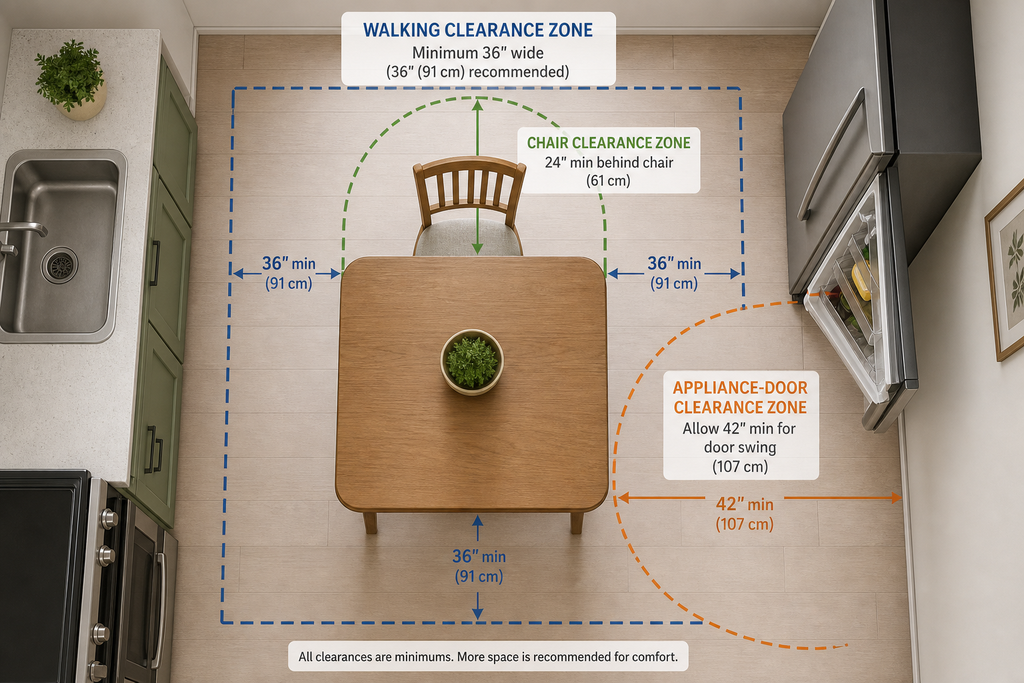
A free option: use masking tape or newspaper to mark the table’s footprint on the floor before buying. Live with it for a day. You’ll quickly discover whether you’re making room for a table—or negotiating around it.
If space is genuinely tight, a slim folding or drop-leaf design may solve the problem without permanently claiming your floor. Just measure both its closed and expanded dimensions before you commit.
The Best Table Shape Depends on Where People Need to Walk
Once you’ve measured the space, the next question is shape. And in a small kitchen, shape isn’t just about looks it can determine whether you glide around the room or bump into the same corner every morning. Choosing the right shape is one of the most impactful decisions when shopping for the Best Kitchen Tables for Small Spaces.
Round Tables: Great When Corners Are the Enemy
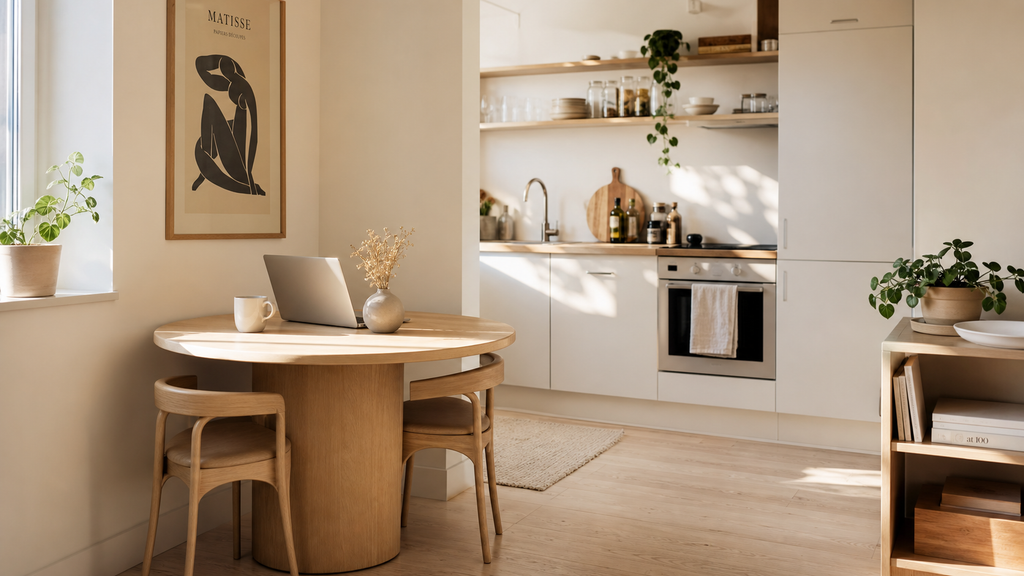
A small round table can make a cramped area feel easier to move around because there are no sharp corners sticking into the walkway. This can work especially well in a two-person breakfast nook between a wall and cabinets.
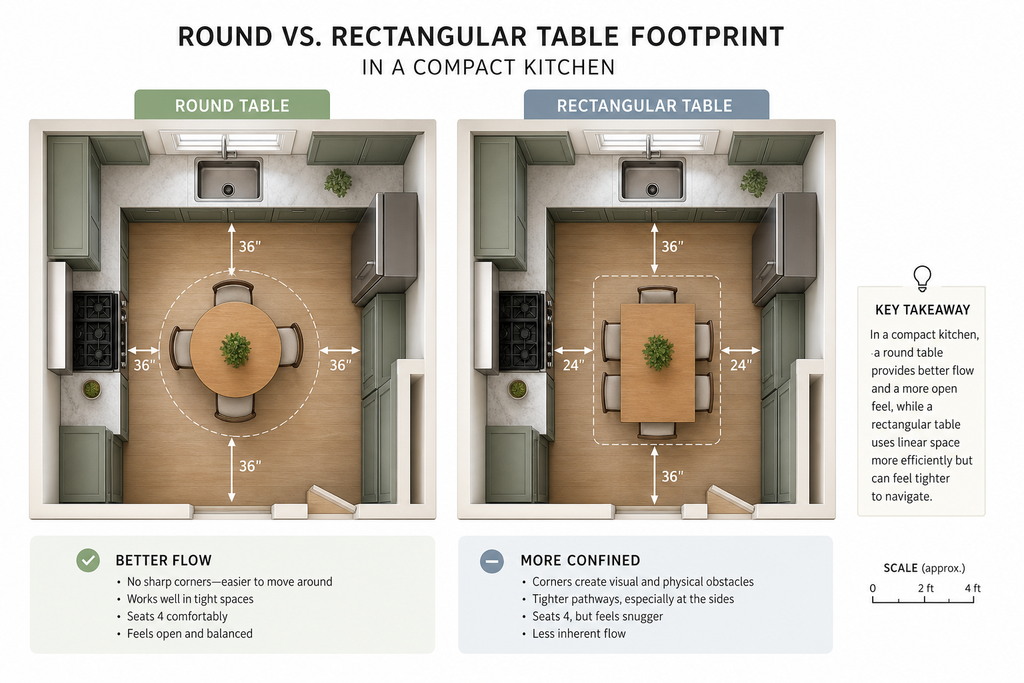
A small pedestal table is worth considering when leg placement matters, but check the base carefully—it can still interfere with feet.
Square Tables: Surprisingly Practical for Two or Four
A compact square table can tuck neatly against a wall and give you a useful surface without stretching too far into the room. Something around 30–36 inches can work for a couple or a small household, depending on the available clearance.
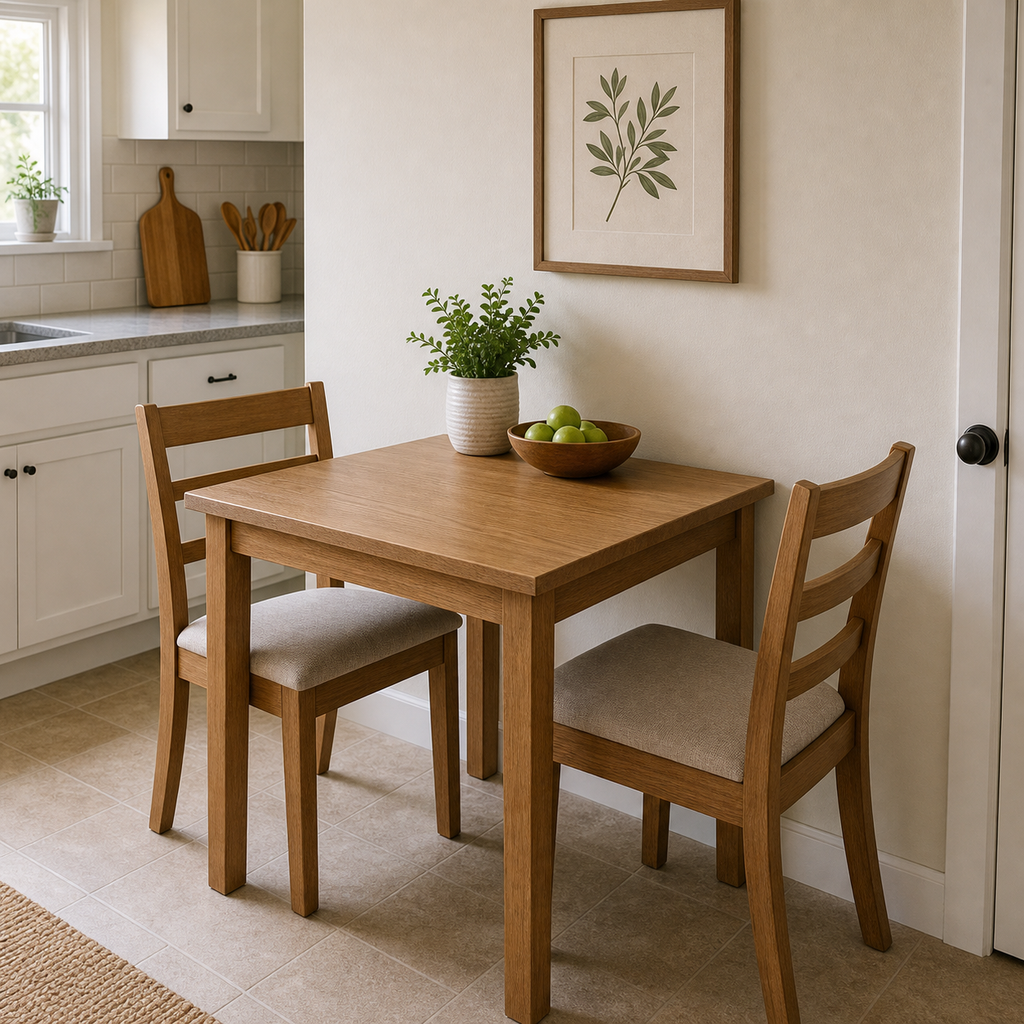
The tradeoff? Four people may feel cozy rather quickly.
Rectangular Tables: Useful When the Room Is Narrow
If your kitchen is long and narrow, a slim rectangular table may follow the room better than a round or square design. A shallow table can work nicely along a wall in a galley-style kitchen.
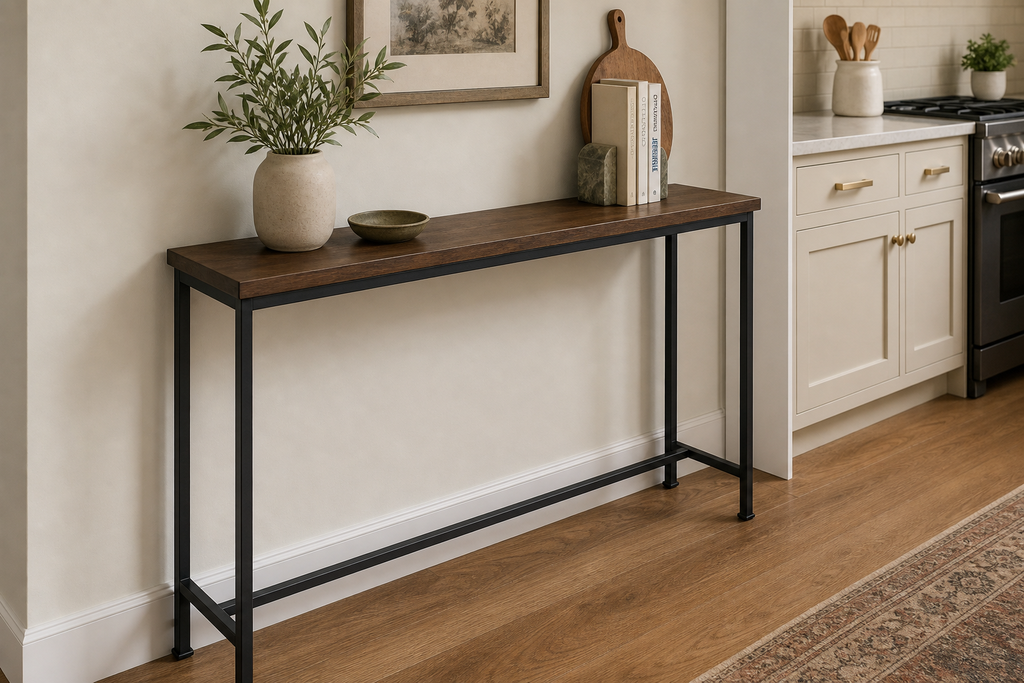
For the best kitchen tables for small spaces, the “right” shape really depends on where people walk. And once the shape is settled, there’s another useful question: does the table need to disappear when you’re not using it?
Drop-Leaf Tables Are a Small-Space Classic for a Reason
If you’ve found the right shape but still need more flexibility, a drop-leaf table can be a very sensible compromise. It stays compact when you need the floor space, then opens up when dinner guests appear—which is why drop-leaf designs consistently rank among the best kitchen tables for small spaces.
A one-leaf design gives you a little extra room, while a two-leaf table can create considerably more seating when fully opened. Some can also sit halfway open, which is handy when you need a bit more surface without taking over the kitchen.
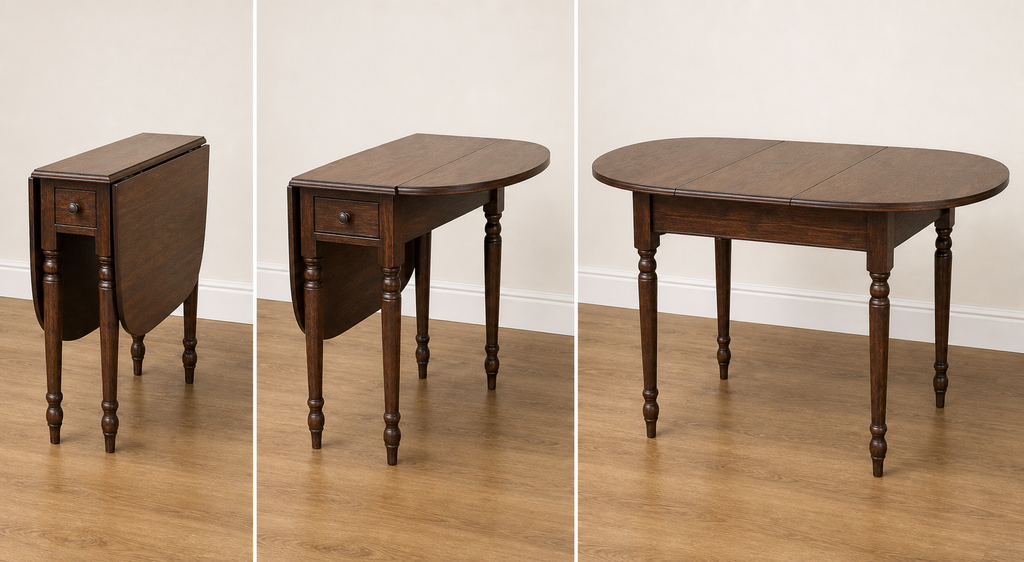
Before buying, check where the leaves rest when folded and how the legs move. A clever tabletop isn’t much help if the support legs end up blocking your knees. Stability matters too, particularly when the table is fully extended.
Imagine two people keeping the table folded during the week, then opening both leaves for Sunday lunch. That’s exactly where this type of space-saving kitchen table earns its keep.
One practical tip: measure the fully opened size, not just the closed footprint. The best kitchen tables for small spaces only work if there’s still somewhere to walk once they’re doing their bigger-table job.
And if even a folded table feels like too much furniture, there’s another option: make the table disappear altogether.
Folding and Wall-Mounted Tables Can Give the Floor Back
A drop-leaf table still needs somewhere to live. But what if even that feels like one too many pieces of furniture? In a genuinely tiny kitchen—or a studio where the kitchen, dining room, and living room are basically roommates—folding options can give that floor space back. These are often the best kitchen tables for small spaces when square footage is at an absolute premium.
Freestanding Folding Tables
These are a straightforward choice when you want flexibility without drilling into a wall. Fold the table away when you need more room, then bring it back for meals or work. They make sense for renters, although you’ll need somewhere to store the folded table.
Wall-Mounted Folding Tables
When floor space is precious, attaching the table to the wall can be remarkably practical. A drop-down table can fold flat when you’re finished eating. The catch? Installation matters. Check the wall construction, mounting requirements, and weight capacity before buying.
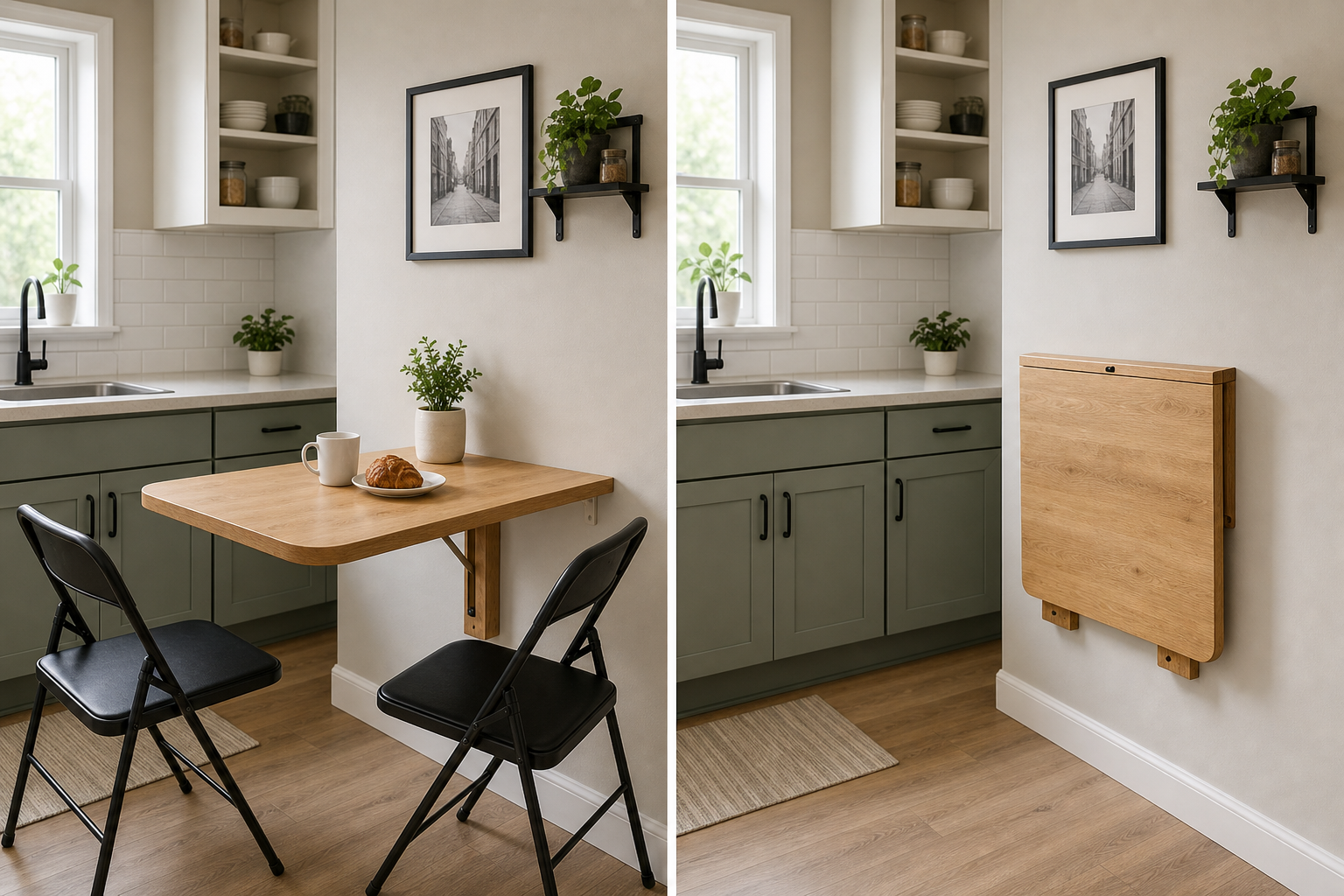
Convertible Tables
If one surface needs to handle breakfast, laptop work, and food prep, a convertible design can earn its place more easily. A compact folding dining table or convertible desk can serve several purposes instead of adding another piece of furniture.
Picture a studio apartment where breakfast ends, the table folds against the wall, and suddenly there’s room to breathe again. That’s the appeal.
A useful no-purchase trick? Try temporarily clearing a wall area and marking the proposed table size with tape. You’ll know surprisingly quickly whether the “space-saving” idea actually saves space.
And once the table can disappear when needed, there’s one more detail worth considering: how comfortable is it when you’re actually sitting at it?
Don’t Ignore the Table Legs—They Can Make or Break a Tiny Kitchen
Once you’ve figured out how the table can fold or move out of the way, there’s another surprisingly important detail underneath it: the legs. Overlooking leg design is one of the most common mistakes people make when searching for the best kitchen tables for small spaces.
Two tables can have almost identical dimensions but feel completely different once you sit down. Four traditional legs are familiar, but one of them might land exactly where someone’s knees want to go. Suddenly, dinner has become a tiny negotiation.
Pedestal and central-support bases can leave more open space around the edges, which can make it easier to position chairs. Trestle bases can also work well, depending on where the supports sit. The key is leg placement, not simply how the table looks from above.
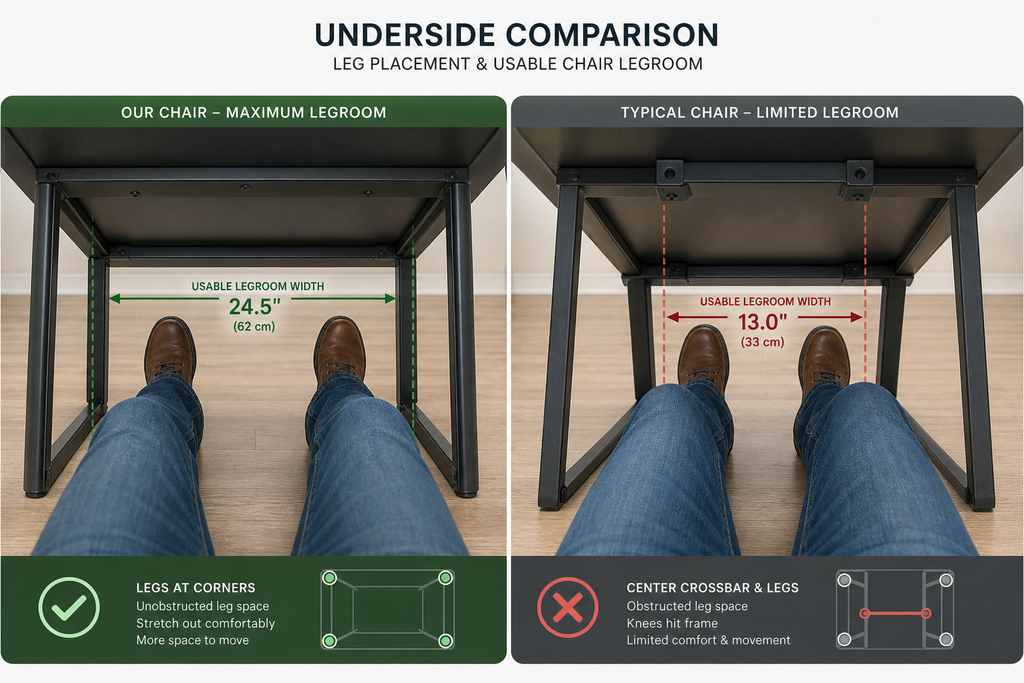
If your kitchen is particularly tight, a pedestal table or design with recessed supports may be worth considering. Just check the base dimensions and stability before buying; more open legroom isn’t useful if the table wobbles.
Here’s a free test: mark the table’s footprint with tape, then place a chair at each intended seating position. Sit down. Move your legs around. It sounds slightly ridiculous, but you’ll notice problems before they become furniture regrets.
And once everyone can actually sit comfortably, the next question is simpler: how many people need to sit there every day?
How Many People Do You Really Need to Seat?
Once you’ve found a table shape that lets everyone sit comfortably, there’s one slightly awkward question: how many people actually need to sit there? Getting this right is crucial when choosing the best kitchen tables for small spaces.
It’s tempting to plan for the biggest gathering you might have. But if two people use the kitchen table every day, why give up precious floor space for six chairs that come out twice a year?
For a couple, a table for two can be wonderfully compact. If you occasionally have family or friends over, a 2–4-person table gives you a little breathing room without permanently taking over the kitchen.
A table for four makes more sense for a small household that regularly eats together, but check the surrounding clearance before choosing one simply because it sounds practical.
Then there are extendable and drop-leaf tables. These can stay compact for everyday meals and expand when guests arrive. That’s particularly useful when your kitchen has to work harder than it really should.
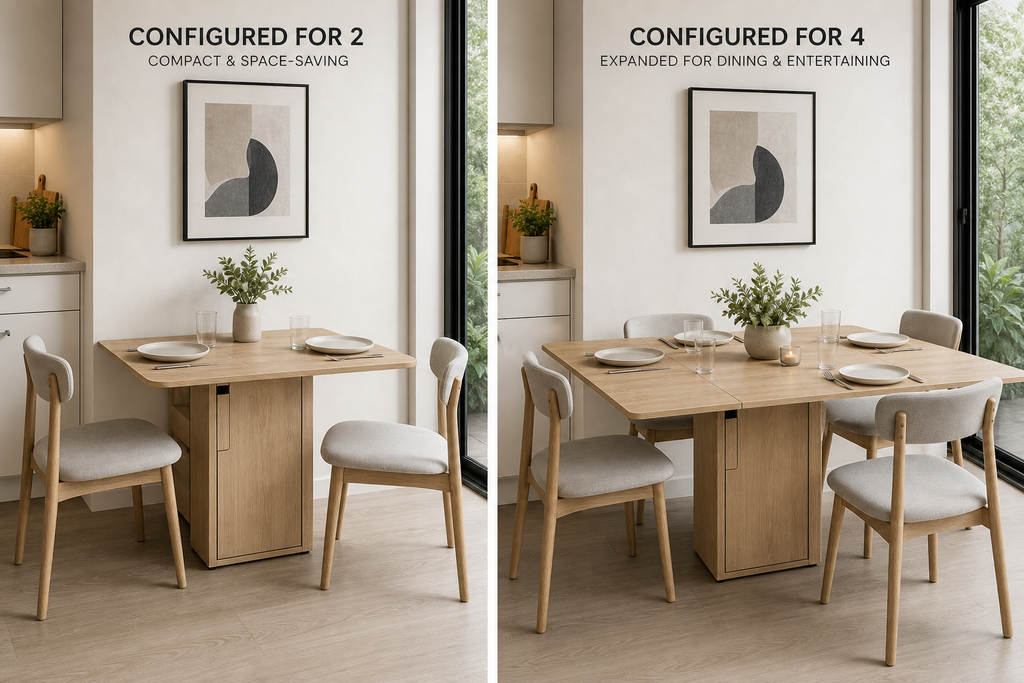
Here’s a no-purchase trick: count how many people actually sit at your table during a typical week. Plan around that number, then make occasional guests the flexible part.
The best kitchen tables for small spaces aren’t necessarily the ones with the most seats. They’re the ones that fit your real life without making Tuesday breakfast feel like a furniture obstacle course.
And if the table is earning its floor space, it may as well earn it twice—with a little storage built in.
Small Kitchen Tables With Storage Can Earn Their Floor Space
If your table is already taking up valuable floor space, it might as well do a little more than hold dinner plates. In a tiny kitchen, built-in storage can make that footprint work harder—and tables with integrated storage are increasingly popular among the best kitchen tables for small spaces.
A drawer can keep napkins, utensils, or everyday placemats close at hand. Shelves or a lower storage rack can hold cookbooks, baskets, or items you use regularly. Some tables even pair with built-in benches, while others include drop-down extensions for extra surface when needed.
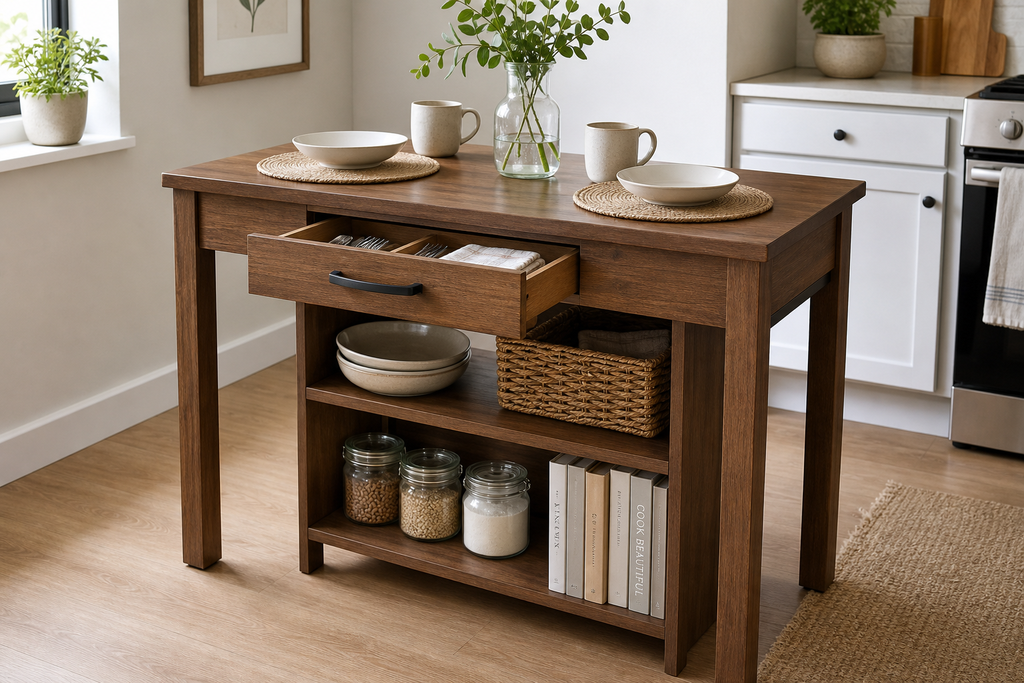
Here’s the catch: storage isn’t automatically better. Extra shelves and bulky bases can make a table look heavier and may make it harder to move or tuck away. If your kitchen needs to stay visually open, a simple drawer may be more useful than a table with an entire shelving unit underneath.
Before buying, think about what you actually need to store. If the answer is just cutlery and napkins, don’t buy a miniature cabinet disguised as a table.
A free solution is to use a basket or slim container underneath an existing table and see whether that extra storage genuinely helps.
For shoppers, a kitchen table with drawers or shelves can be worth considering when cabinet space is limited. Just measure the storage area as carefully as the tabletop—you still need comfortable legroom.
And because small kitchens tend to see a lot of spills, crumbs, and general daily chaos, the next thing to consider is what the tabletop itself is made to handle.
The Materials Matter More in a Small Kitchen Than You Might Think
If your table is doing double duty as storage, dining space, and workspace, the tabletop itself deserves a closer look. In a small kitchen, one surface often has to handle breakfast, coffee, laptops, homework, and the occasional food-prep emergency. Material durability is a surprisingly important factor when narrowing down the best kitchen tables for small spaces.
Here’s the thing: different materials behave very differently under that kind of daily use.
Solid wood offers a warm, classic look and can feel substantial, but it may need more care and can be sensitive to moisture and heat. Engineered wood can offer a similar appearance at a lighter weight, although the finish and construction vary. Laminate is often appealing for busy households because it’s generally easy to wipe clean, while metal can be durable and practical but may feel more industrial. Glass keeps a small room looking visually open, though fingerprints, crumbs, and cleaning can become part of your daily routine.
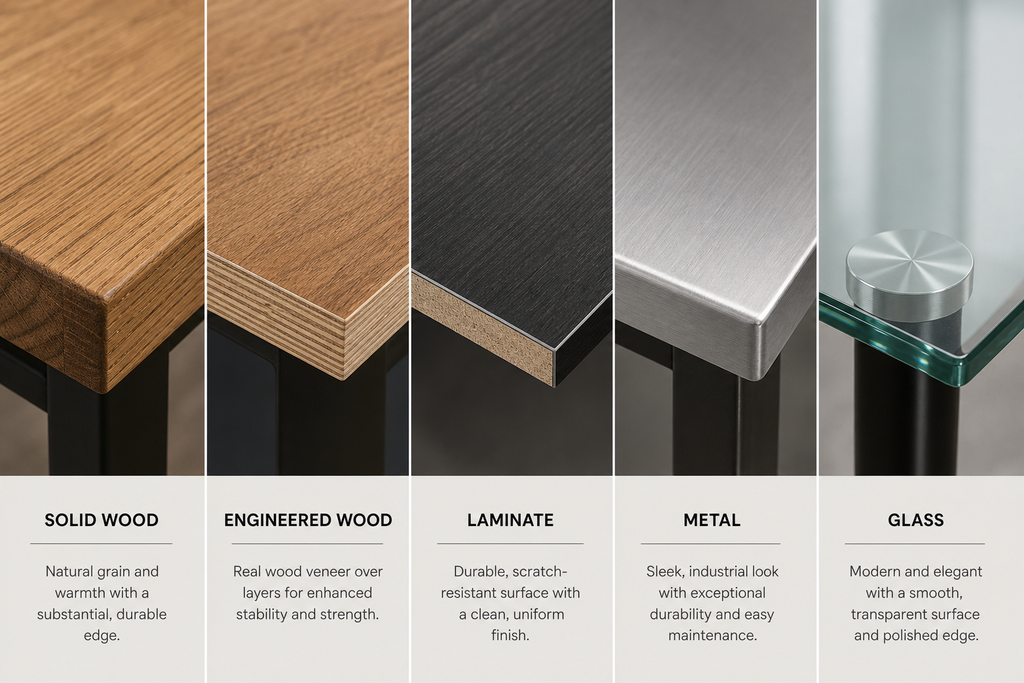
Think about how you actually live. If your kitchen table doubles as a work-from-home desk, a durable, easy-clean surface may make more sense than a delicate finish that requires constant attention.
And yes, there’s a catch: lighter tables are easier to move, while heavier materials can feel more substantial. The best kitchen tables for small spaces aren’t just about saving floor space—they should also survive the life happening around them.
Before buying, consider cleaning, water and heat exposure, maintenance, and how easily the table can be moved. A simple table mat or coaster routine can also help protect an existing table without spending anything.
Once the material makes sense for your daily routine, comparing tables gets much easier because you’re no longer choosing on looks alone.
5–15 Product Comparison Categories That Actually Help
Once you know what kind of material and construction suits your daily routine, comparing actual tables becomes much easier. But generic specs don’t always tell you what you really need to know.
A table might look compact on paper and still block the refrigerator. A “four-person” table might technically seat four while leaving everyone elbow-to-elbow.
So for the Best Kitchen Tables for Small Spaces, the comparison should focus on questions that matter in real homes.
The most useful categories are overall dimensions, folded or closed dimensions, expanded dimensions, shape, seating capacity, table height, and leg or base design. Together, these tell you whether the table fits, how it behaves when opened, and whether people can actually sit comfortably.
Storage and material are useful too, particularly if cabinet space is limited or the table will be used heavily. Weight matters when the table needs to move, while assembly requirements can be important for renters or anyone who doesn’t want a Saturday afternoon wrestling with furniture instructions.
For expandable designs, look closely at the extension mechanism. Knowing that a table expands is helpful; knowing how easily it changes size is much more useful.
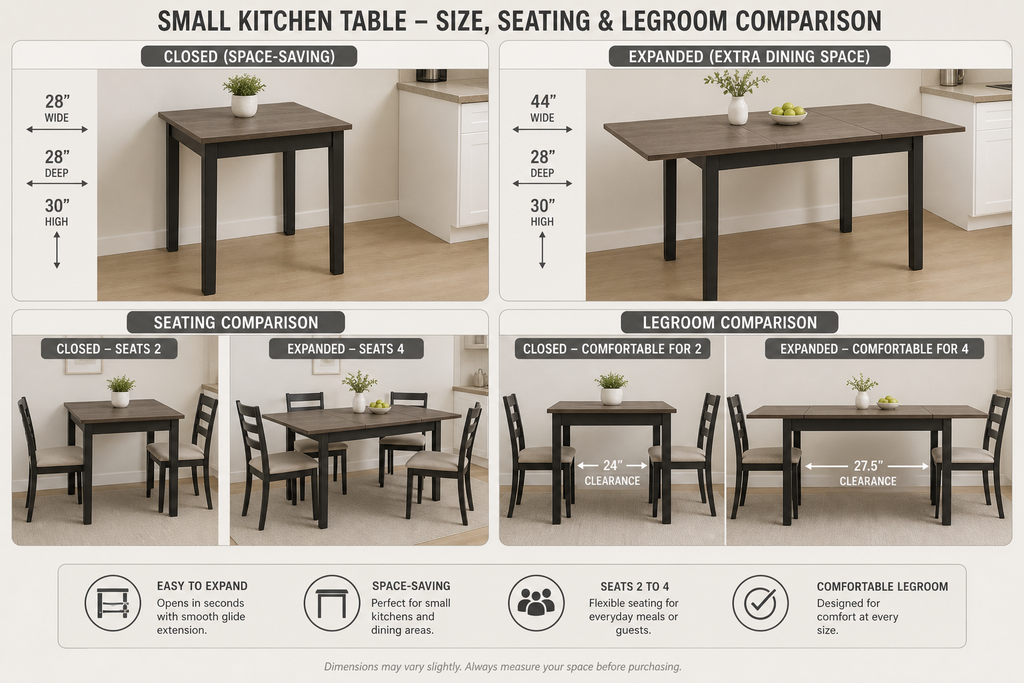
Cleaning and maintenance, “best suited for,” and the main tradeoff can round out the comparison. That last one matters. Every space-saving table has some compromise.
There’s no need to cram all 15 categories into one enormous table, either. A handful of the most important specs can sit in the main comparison, while individual reviews explain the details that actually affect everyday use.
That way, you’re comparing tables as solutions to small-space problems—not simply collecting numbers.
Our Small-Space Kitchen Table Shortlist
After all that measuring, folding, legroom, and material talk, you’re probably ready to see some actual tables.
The trick is not to crown one table as the universal winner. A compact table that works beautifully for two people can be completely impractical for a family, while a storage-heavy design may feel unnecessary in a kitchen that already has plenty of cabinets.
So this shortlist focuses on specific needs instead.
Best for Two People
Look for a genuinely compact footprint with enough surface for comfortable everyday meals.

- 【Compact Design】 – This small dining table set features a compact design to be perfect for small room and apartment. And…
- 【Sturdy Frame】- The table and stools are mainly made with MDF panel and steel which is durable and solid enough to suppo…
- 【Widely Use】- A smooth tabletop with metal legs adds a modern and stylish. It is perfect for kitchen, bar, apartment, sm…
Why it works: This type of table makes sense when two people use the kitchen regularly and preserving floor space matters more than accommodating a large group.
Check before buying: Measure the tabletop, chair clearance, and space needed to move around it.
Best Drop-Leaf Option
A table that stays small during the week but expands when guests arrive can make a lot of sense.

- SPACE SAVING DROP LEAF DESIGN – Maximize your dining area with a dual drop-leaf mechanism. The table depth shrinks to a …
- PERFECT FIT FOR SMALL SPACES – Comfortably seat up to four people without overcrowding your room. When fully expanded to…
- STURDY FOUR LEG BASE – Enjoy a stable and comfortable dining experience every time you sit down. Built with four flared …
Why it works: You get a compact everyday footprint with additional surface when you need it.
Check before buying: Look at both the closed and fully expanded dimensions, and make sure the opened table doesn’t interfere with nearby cabinets or appliances.
Best for Narrow Kitchens
Long, shallow designs can work better than wide tables when every inch of walkway matters.

- Partner for Small Space: The console table with a size of 29.5″L x 9.5″W x 29.5″H. Use it as a slim sofa table behind yo…
- Modern Industrial Style: Featuring a sleek black metal frame paired with rustic brown wood panels, this console table bl…
- Multifunctional Console Table: The sofa table cannot only be placed at the entryway to store keys, magazines and a hallw…
Why it works: A slim rectangular shape can follow the proportions of a galley-style or narrow kitchen more naturally.
Check before buying: Measure the remaining walkway, not just the space where the tabletop will sit.
Best With Storage
Choose this category when drawers or shelves can replace some of the storage you’re missing elsewhere.

- Modern Design: This extendable dining table features a contrasting color combination and a floating design, creating a s…
- Flexible Dining/Work Solution: The folding tabletop expands your workspace effortlessly. High-quality slides with hidden…
- Smart Storage Solutions: Two top hidden drawers keep small items organized. The left side features a glass-door compartm…
Why it works: The table does more than provide a dining surface, which can make its floor footprint easier to justify.
Check before buying: Make sure the storage doesn’t interfere with legroom or make the table too bulky for your space.
Best Folding Option
Ideal when you need the kitchen table to disappear after meals, work, or food prep.

- FOLDABLE AND PORTABLE: Byliable 4 ft small folding table can be folded in the middle, buckled with a safety buckle, very…
- RUGGED AND STABLE: Made of high-density polyethylene (HDPE), thicker and harder, have better quality. The desktop of thi…
- STRONG SUPPORT: Powder-coated steel legs and gravity locks help to completely fix the table at any time and any place. I…
Why it works: Folding designs can free up floor space when the table isn’t needed.
Check before buying: Consider where the folded table will go. A table that folds but has nowhere sensible to be stored hasn’t completely solved the problem.
Best Budget-Friendly Option
Rather than chasing the lowest price, look for useful features, sensible construction, and a size that genuinely fits.

- Space-saving Design – 3 Pieces two Chairs and Table Set is elegent for any compact space, the chairs can be tucked under…
- Kitchen Table Set – Simple and modern design makes it perfect for any home decoration style. You can put them into kitch…
- Built-in Wine Rack – A built-in Wine Rack for wines, snacks, fruits and books is designed directly under the table to ad…
Why it works: A less expensive table can still be practical if it has the right dimensions, useful construction, and features for your room.
Check before buying: Don’t sacrifice the measurements that matter simply to save money. Replacing an unsuitable table later can cost more than choosing the right size in the first place.
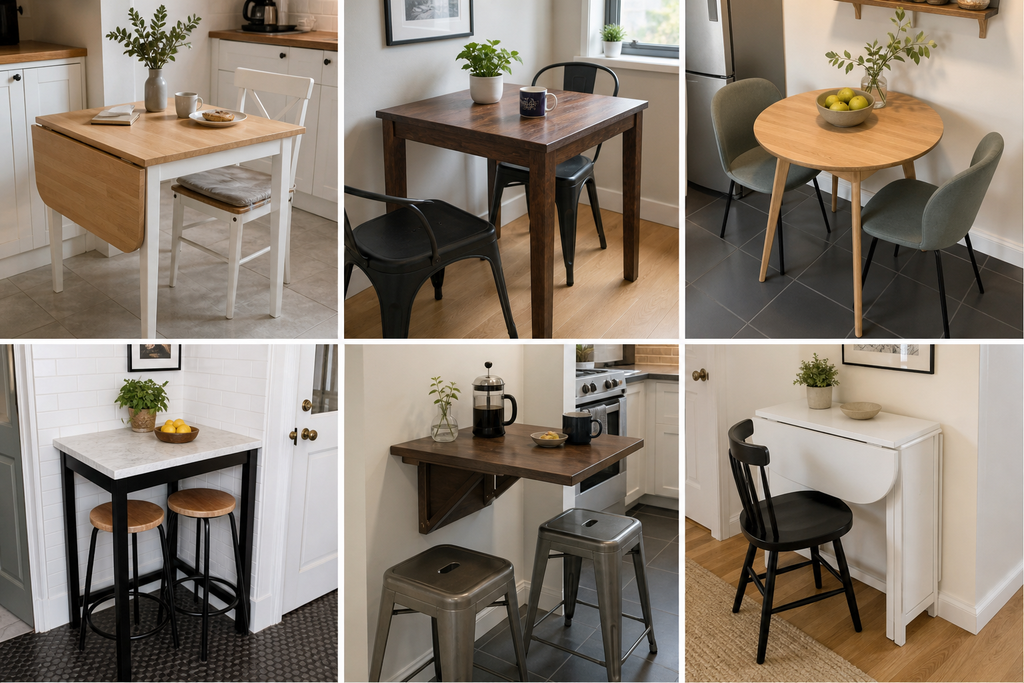
Before choosing any option, measure your available space—and remember that the best kitchen tables for small spaces are the ones that solve your particular problem.
A Few Small-Space Table Mistakes You’ll Be Glad You Avoided
A table can have the perfect tabletop dimensions and still be completely wrong for your kitchen. The most common mistake is forgetting everything around it.
Don’t just measure the tabletop. Check chair clearance, walking space, cabinet doors, and the refrigerator path too. A four-person table might look perfect online, only to leave one person practically wedged between the table and the fridge.
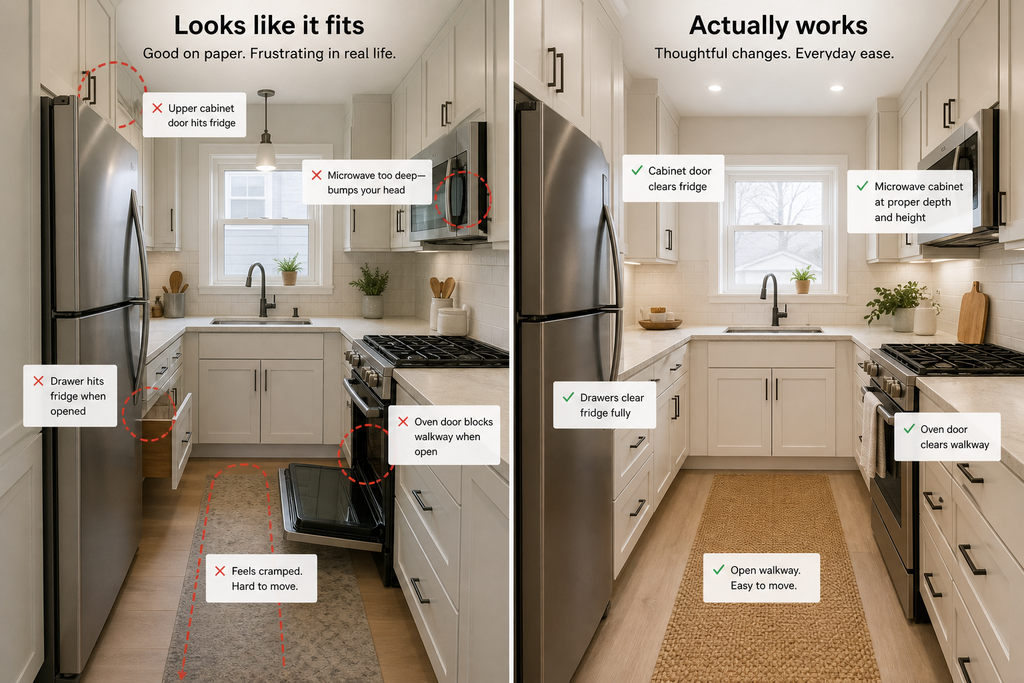
It’s also easy to overlook the legs, choose seating that won’t tuck underneath, or buy a table that’s so heavy you’ll never want to move it. And “extendable” doesn’t automatically mean practical—check how easily it opens and whether there’s still enough room when fully extended.
Then there’s the temptation to plan for maximum seating instead of everyday comfort. Why squeeze four people around a table every day just because you might host four once a year?
Before buying, ask one simple question: Where does this table go when I need the floor space back?
That answer can eliminate a surprising number of otherwise tempting options.
So, What Is the Best Kitchen Table for a Small Space?
After all that measuring, comparing, and imagining chairs in places they probably shouldn’t be, the answer is actually fairly simple: it depends on what your kitchen needs most.
Very tight floor space? A folding or wall-mounted table can give the floor back.
Need flexibility? Look at drop-leaf or expandable designs.
Have a narrow room? A slim rectangular table may fit the layout better.
Dealing with awkward corners? A round or pedestal table can make movement easier.
Mostly two people? A compact two-person table may be all you need.
Short on storage? A table with drawers or shelves can earn its footprint.
Host guests regularly? An expandable design can provide extra seating without taking up that space every day.
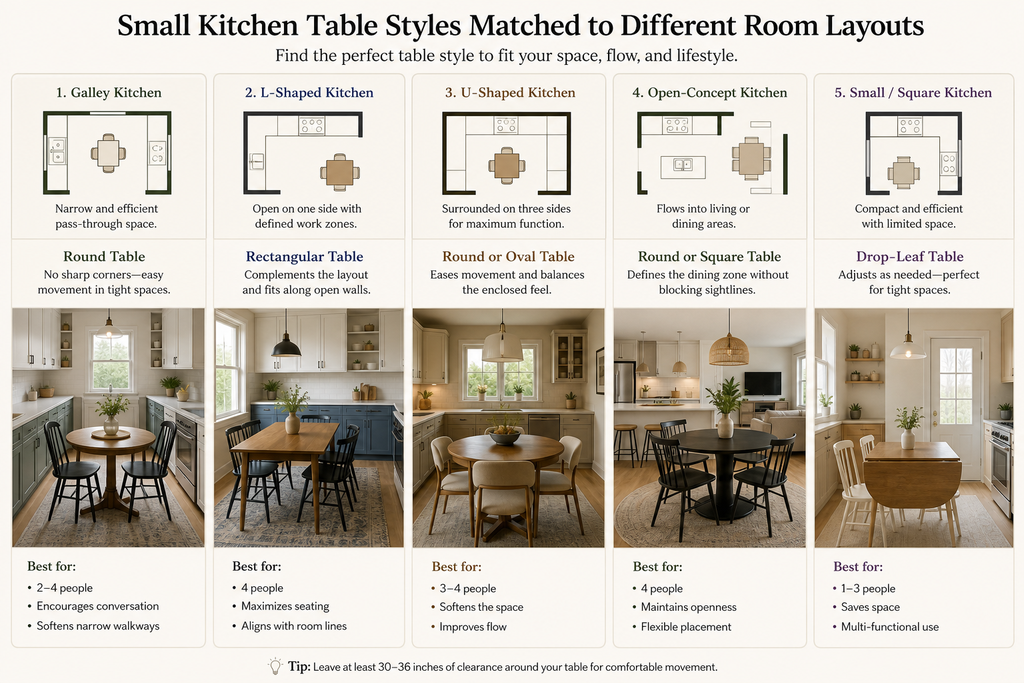
Before buying, measure the space, account for chairs and walking clearance, and think about how you’ll use the table on an ordinary Tuesday—not just when guests arrive.
The right table isn’t necessarily the smallest one.
It’s the one that gives you the most useful table without making the rest of your kitchen miserable.
Conclusion
Finding the Best Kitchen Tables for Small Spaces isn’t really about squeezing the tiniest table into the room. It’s about choosing something that works with the way you actually live.
Start with the basics: measure the available floor space, leave room for chairs and walking, then choose the shape and features that solve your biggest problem. Maybe that’s a drop-leaf table, a narrow design, built-in storage, or simply a smaller table that comfortably fits two.
If you’re not ready to buy anything, that’s fine too. Mark your table footprint with tape, move a chair around it, and see what feels awkward. Sometimes one small adjustment reveals more than an hour of scrolling through furniture listings.
You can also explore How to Organize a Refrigerator Without Wasting Space for more ways to make your kitchen look good and arrange everything correctly.
Your space doesn’t have to be perfect. It just has to work for you. So, what’s one small kitchen problem you can fix today?