15 Small Kitchen Organization Ideas That Actually Work
This article contains affiliate links. If you purchase through these links, we may earn a small commission at no extra cost to you.
Discover 15 small kitchen organization ideas that actually work. Learn how to maximize storage, reduce clutter, and make your tiny kitchen feel bigger.
A small kitchen can feel frustrating when every cabinet, drawer, and countertop seems to be working overtime. But you don’t necessarily need a bigger kitchen. You need to make better use of the space you already have.
The best small kitchen organization ideas focus on one simple principle: every inch should have a purpose. A narrow cabinet can hold spices, the empty space under a shelf can store mugs, and an unused corner can become valuable storage with the right organizer.
We’ve gathered 15 practical ideas that can help you maximize space in a small kitchen without making it feel crowded. Many are affordable, renter-friendly, and easy to implement in an afternoon.
And if you’re also looking for furniture, we’ll cover smart options such as a space saving kitchen table, small kitchen tables with storage, and drop-leaf designs that can make a compact kitchen much more functional.
1. Start by Decluttering Your Kitchen
Before buying another organizer, take everything out of your cabinets and drawers.
This might sound obvious, but it’s one of the most effective small kitchen organization ideas because storage becomes much easier when you’re not trying to organize things you never use.
Create three groups:
- Keep
- Donate
- Throw away
Check for duplicate utensils, expired food, unused appliances, mismatched containers, and gadgets you haven’t touched in months.
For example, if you have three vegetable peelers but regularly use only one, two are taking up valuable drawer space.
Quick tip: Don’t organize clutter. Remove it first.
Once you’ve reduced the number of items in your kitchen, you’ll know exactly where additional storage solutions are needed.
2. Add Cabinet Shelf Risers
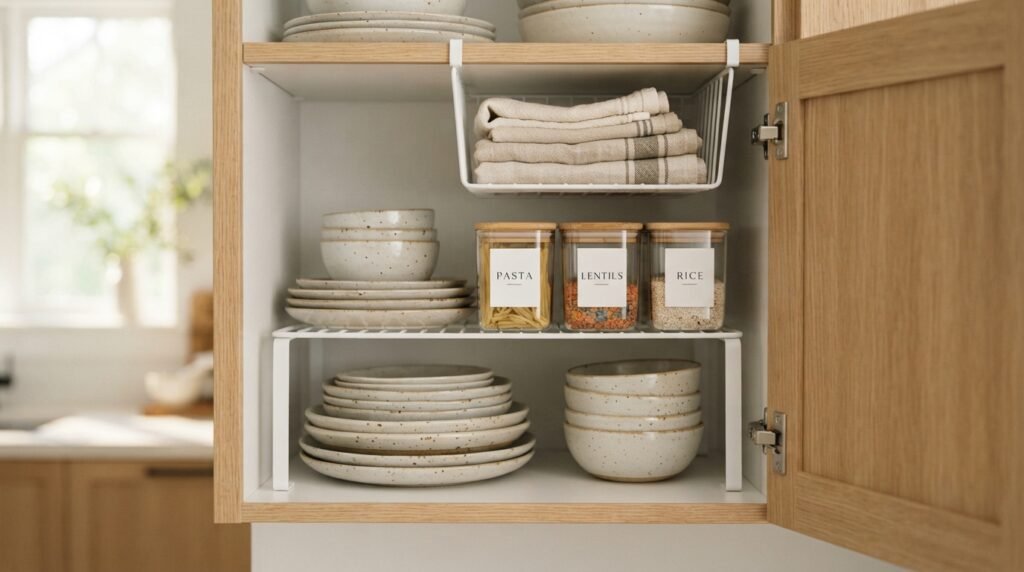
One of the easiest ways to increase cabinet capacity is to use shelf risers.
Tall cabinets often have several inches of unused vertical space. Instead of stacking plates, bowls, or cans into unstable piles, a shelf riser creates another usable level.
You can use them for:
- Plates
- Bowls
- Mugs
- Canned foods
- Glasses
- Small appliances
Why shelf risers work
Think of a cabinet like a two-story building. If everything sits on the ground floor, you’re wasting the second floor.
A shelf riser effectively creates that second floor without remodeling the cabinet.
Amazon Pick: Cabinet shelf risers
3. Use Under-Shelf Baskets
Here’s another small kitchen storage trick that doesn’t require drilling.
Under-shelf baskets slide underneath existing shelves and create additional storage space.
They’re particularly useful for lightweight items such as:
- Kitchen towels
- Cutting boards
- Foil and plastic wrap
- Small plates
- Coffee supplies
- Cleaning cloths
They’re also useful when your cabinets have awkward vertical gaps.
Instead of letting that empty space collect dust, turn it into storage.
Amazon Pick: Under-shelf baskets
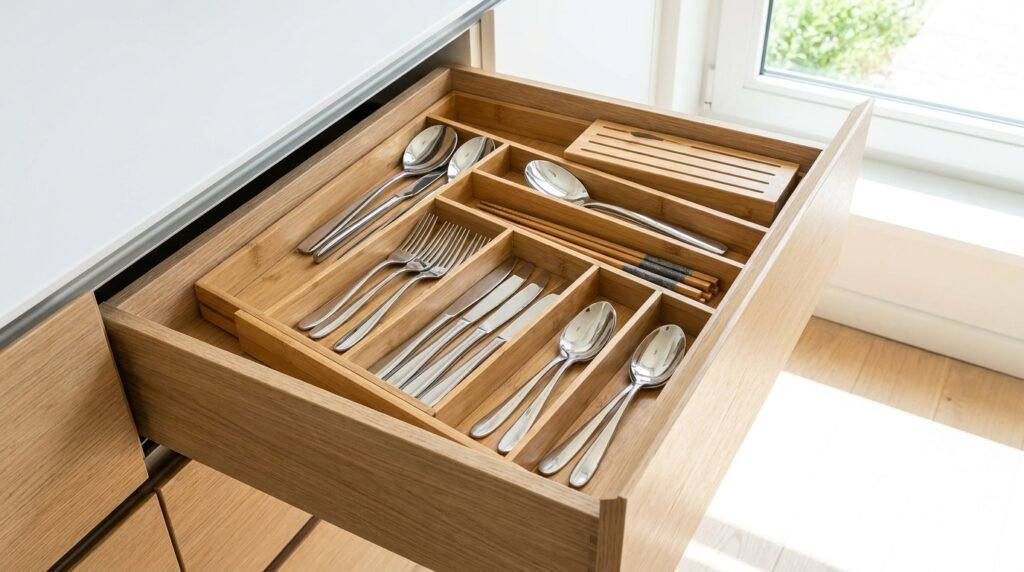
4. Organize Drawers by Category
A messy kitchen drawer can make a small kitchen feel even smaller.
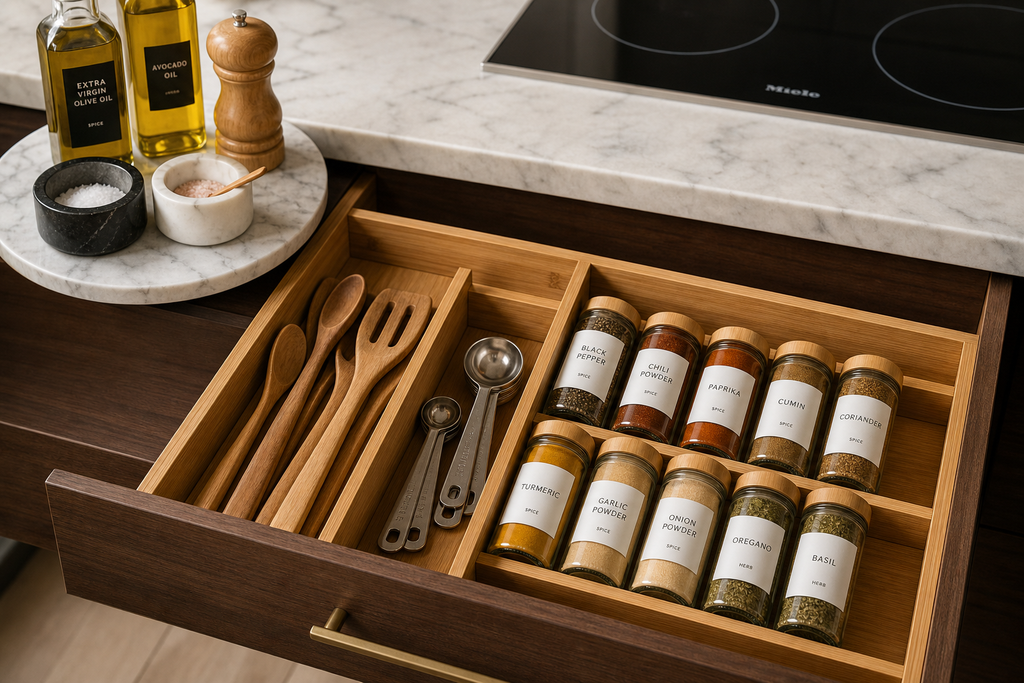
When utensils are mixed together, you often need to dig through everything to find one item. A drawer organizer separates the space into useful categories.
Try creating sections for:
- Cooking utensils
- Measuring tools
- Cutlery
- Gadgets
- Food preparation tools
Adjustable drawer dividers are especially helpful because you can customize the layout around your actual utensils.
Don’t overfill your drawers
Organization isn’t about fitting as much as possible into one drawer.
It’s about making everything easy to see and reach.
If you need to move five utensils before finding a spatula, the drawer isn’t really organized.
Amazon Pick: Adjustable drawer organizers
5. Install a Slim Rolling Kitchen Cart
A narrow rolling cart can turn an unused gap into valuable storage.
Look for a cart designed for tight spaces. Slim models can fit between appliances, cabinets, or walls while providing several storage levels.
Use one for:
- Canned foods
- Spices
- Snacks
- Coffee supplies
- Cleaning products
- Small appliances
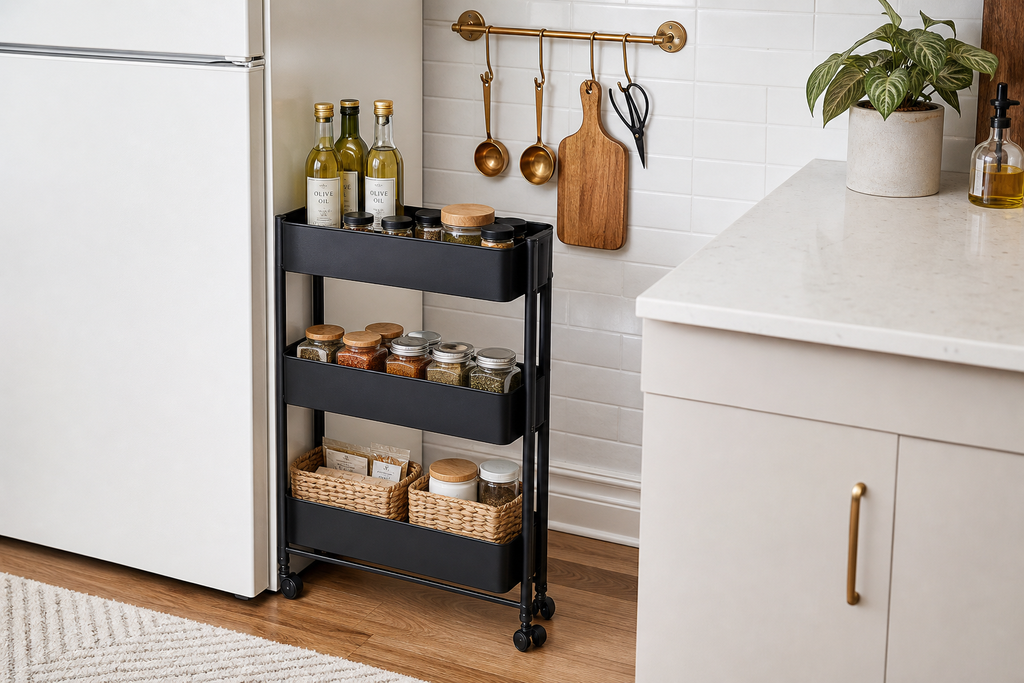
The biggest advantage is flexibility.
You can pull the cart out when you need something and slide it back afterward.
This makes it one of the most practical space saving kitchen ideas for renters and apartment dwellers.
Amazon Pick: Slim rolling kitchen carts
6. Make the Most of Cabinet Corners
Corner cabinets are notorious for becoming storage black holes.
You put something inside and forget about it because reaching the back is difficult.
A rotating organizer, such as a Lazy Susan, solves much of this problem.
Instead of reaching behind several bottles, simply rotate the organizer until the item comes forward.
What should go on a Lazy Susan?
Try using one for:
- Sauces
- Oils
- Vinegar
- Condiments
- Canned foods
- Baking ingredients
This is especially helpful when learning how to organize a small kitchen because difficult-to-reach areas become accessible storage.
Amazon Pick: Lazy Susan organizers
7. Create a Dedicated Spice Zone
Spice jars are small, but they can create surprisingly large amounts of clutter.
Instead of keeping them scattered across multiple cabinets, create one dedicated spice area.
A compact spice rack can be placed inside a cabinet, on a countertop, or on a wall depending on your kitchen layout.
Arrange spices alphabetically or according to how frequently you use them.
For example, everyday spices can stay near the cooking area while less frequently used spices can go higher up.
Amazon Pick: Compact spice rack organizers
8. Switch to Stackable Food Containers
Food containers are another common source of kitchen clutter.
Different shapes and sizes don’t stack efficiently. Lids disappear, containers fall over, and cabinets quickly become difficult to manage.
A matching set of stackable containers can solve this problem.
Look for containers with:
- Similar shapes
- Stackable designs
- Secure lids
- Transparent sides
- Multiple sizes
Clear containers also make it easier to see what you have.
This can reduce the temptation to buy something you already have hiding in the back of a cabinet.
Amazon Pick: Stackable food storage containers
9. Use the Back of Cabinet Doors
Don’t forget about the space behind your cabinet doors.
It’s often completely unused.
An over-the-cabinet-door organizer can create additional storage without permanent installation.
Depending on the design, you can use one to store:
- Cutting boards
- Foil
- Plastic wrap
- Cleaning supplies
- Sponges
- Kitchen towels
- Small bottles
This is particularly useful for small kitchen organization ideas for renters because many options don’t require drilling or permanent modifications.
Amazon Pick: Over-the-cabinet-door organizers
10. Choose a Space-Saving Kitchen Table
Your kitchen table can either help your small kitchen or make it feel cramped.
A large rectangular table may look attractive in a spacious kitchen, but it can consume most of the available floor space in a small room.
Instead, consider a compact table designed specifically for small spaces.
Look for:
- Narrow dimensions
- Built-in storage
- Folding components
- Lightweight construction
- Drop-leaf extensions
A space saving kitchen table should give you enough room to eat or work without permanently occupying valuable floor space.
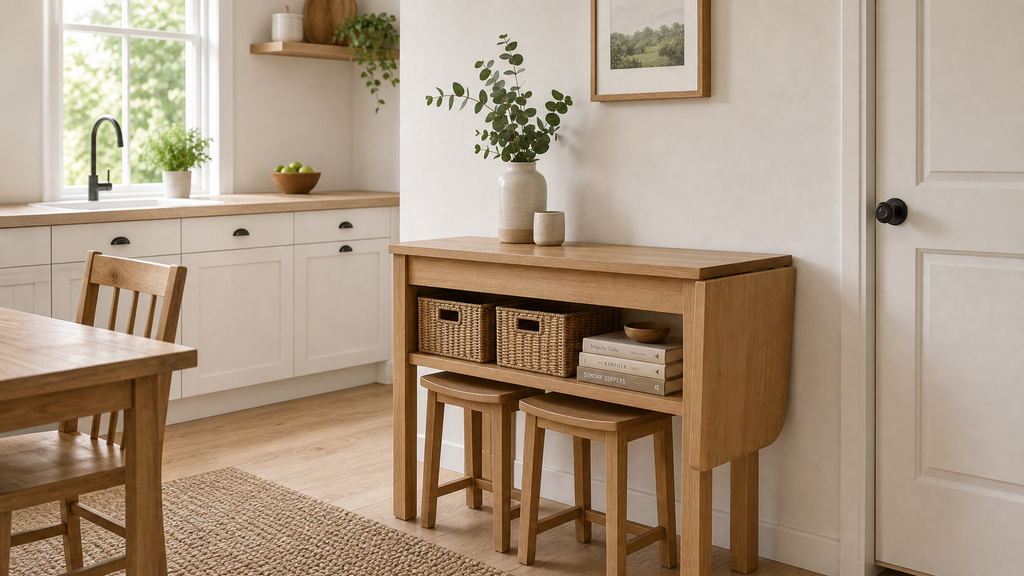
Small kitchen table with storage
A table with shelves, drawers, or a lower storage area can perform two jobs at once.
For example, the lower shelf could hold:
- Cookbooks
- Baskets
- Napkins
- Kitchen appliances
- Serving dishes
That’s valuable in a tiny kitchen because you’re gaining storage without adding another cabinet.
11. Consider a Drop-Leaf Table
If your kitchen doubles as a dining room, workspace, or living area, a drop-leaf table can be an excellent choice.
A drop-leaf table has hinged sections that can be folded down when they’re not needed.
Keep one or both sides folded when you’re cooking.
Then raise the leaf when it’s time to eat.
It’s similar to having an expandable desk: you only use the space when you actually need it.
Why choose a drop-leaf table for a small kitchen?
It’s particularly useful when:
- Your kitchen has limited floor space
- You live in an apartment
- You regularly eat at home
- You need a temporary workspace
- You don’t want a large permanent dining table
12. Try a Round Table in Tight Corners
When comparing a round vs rectangular table for a small space, don’t automatically assume rectangular is better.
A round pedestal table can work surprisingly well in compact kitchens.
The biggest advantage is the absence of sharp corners.
This can make it easier to move around the table, especially when the table is positioned near a walkway.
A pedestal base can also provide more usable legroom than a traditional four-legged design.
Round vs. rectangular: Which is better?
| Feature | Round Table | Rectangular Table |
|---|---|---|
| Best for | Tight corners | Narrow walls |
| Movement | Easier around edges | Can create tight corners |
| Seating | Flexible | More structured |
| Small kitchens | Excellent for some layouts | Excellent for narrow layouts |
| Storage options | Depends on design | More common |
| Space efficiency | Great in square rooms | Great in long rooms |
The right choice depends on your kitchen’s shape.
If your room is long and narrow, a slim rectangular table may work better. If you have a compact square kitchen, a round pedestal table may be easier to navigate.
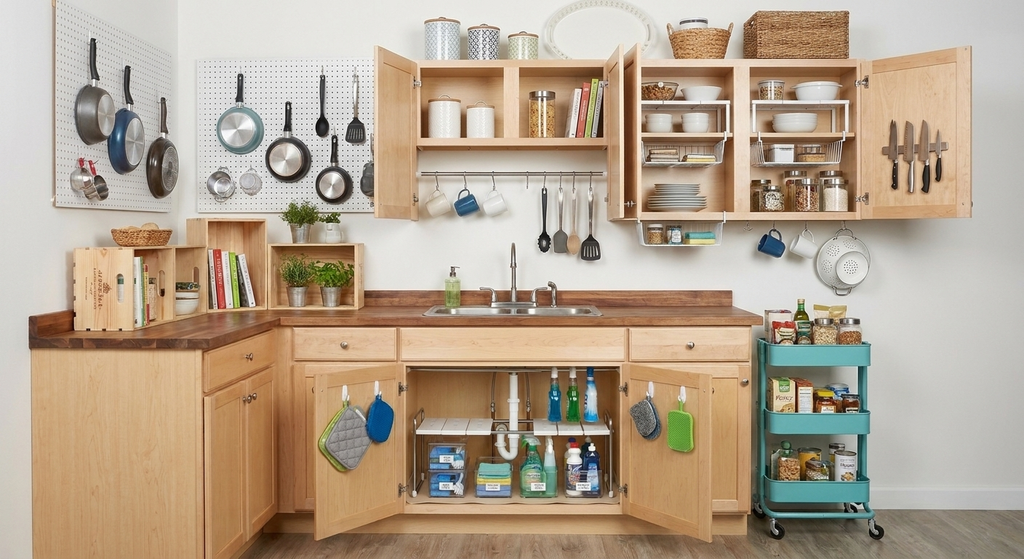
13. Use Vertical Wall Space
When floor and cabinet space are limited, look up.
Walls provide valuable storage opportunities that are often overlooked.
Depending on whether you’re renting or owning, you could use:
- Wall-mounted shelves
- Pegboards
- Magnetic knife strips
- Hanging rails
- Hooks
- Floating shelves
For renters, removable hooks and freestanding solutions can provide similar benefits without permanent modifications.
The goal isn’t to cover every wall with storage.
Instead, choose one or two vertical areas where storage will make the biggest difference.
14. Create Zones Instead of Random Storage
One of the biggest improvements you can make is organizing your kitchen according to activities.
Rather than storing items wherever there happens to be room, create functional zones.
Cooking zone
Keep pots, pans, spatulas, and cooking oils near the stove.
Food preparation zone
Store cutting boards, knives, mixing bowls, and measuring tools near your main preparation area.
Coffee zone
Keep coffee, mugs, filters, and accessories together.
Cleaning zone
Group dish soap, sponges, brushes, and cleaning products near the sink.
This approach makes your kitchen easier to use because everything you need for a particular task is located nearby.
15. Keep Frequently Used Items Accessible
Finally, don’t hide the things you use every day.
If you make coffee every morning, your coffee supplies shouldn’t be buried at the back of a cabinet.
If you cook dinner every evening, your most-used pans should be easy to reach.
A good small kitchen organization system should reduce the number of steps required to complete everyday tasks.
Try this simple rule:
Daily-use items = easiest access.
Weekly-use items = standard cabinet storage.
Rarely used items = higher or less accessible storage.
This small change can make your kitchen feel dramatically more convenient.
How to Maximize Space in a Small Kitchen
If you only remember a few principles from these small kitchen organization ideas, make them these:
- Use vertical space.
- Take advantage of cabinet doors.
- Create additional levels inside cabinets.
- Use narrow gaps for rolling carts.
- Choose furniture that performs multiple functions.
- Keep frequently used items within easy reach.
- Declutter before buying more storage.
The goal isn’t to fill every available inch.
It’s to make every inch work harder.
A shelf riser can turn one cabinet level into two. A rolling cart can transform a narrow gap into a pantry. And a drop-leaf table can provide a dining surface without permanently taking over your kitchen.
The Best Products for Small Kitchen Organization
If you’re ready to improve your kitchen without remodeling, these are some of the most useful products to consider:
| Product | Best For | Why It Helps |
|---|---|---|
| Cabinet shelf risers | Cabinets | Adds vertical storage |
| Under-shelf baskets | Empty shelf space | Uses overlooked space |
| Drawer organizers | Kitchen drawers | Keeps utensils separated |
| Slim rolling cart | Narrow gaps | Creates mobile storage |
| Lazy Susan | Corners | Makes items easier to reach |
| Spice rack | Spices | Keeps small jars organized |
| Stackable containers | Pantry/cabinets | Uses vertical space |
| Door organizers | Cabinet doors | Adds storage without cabinets |
| Drop-leaf table | Dining areas | Folds away when unused |
| Small table with storage | Compact kitchens | Combines furniture and storage |
Small Kitchen Organization Ideas on a Budget
You don’t need to spend hundreds of dollars to organize a small kitchen.
Start with the areas causing the most frustration.
If your cabinets are overflowing, try shelf risers.
If your drawers are messy, start with one drawer organizer.
If you have an awkward gap, measure it before shopping for a slim cart.
And if your dining table takes up too much room, consider whether a folding or drop-leaf model could give you back some floor space.
A simple budget strategy
Step 1: Declutter what you don’t use.
Step 2: Measure your available storage.
Step 3: Identify your biggest problem area.
Step 4: Buy one organizer that solves that specific problem.
Step 5: Reassess before buying more products.
This prevents you from purchasing random organizers that don’t actually fit your kitchen.
Small Kitchen Organization Ideas for Renters
Renters have an extra challenge because permanent modifications may not be allowed.
Fortunately, many storage solutions can work without drilling.
Consider:
- Under-shelf baskets
- Shelf risers
- Over-the-door organizers
- Rolling carts
- Countertop organizers
- Stackable containers
- Freestanding shelves
- Removable hooks
The key is to prioritize portable small kitchen storage.
When you eventually move, you can take the organization system with you.
Final Thoughts: Make Your Small Kitchen Work Harder
The best small kitchen organization ideas don’t require a complete renovation.
They require smarter decisions about how you use the space.
Start by removing things you don’t need. Then use vertical space, cabinet doors, corners, narrow gaps, and multifunctional furniture to create storage where you didn’t realize you had it.
And don’t overlook your kitchen table.
A space saving kitchen table, small kitchen table with storage, drop-leaf table, or compact round pedestal table can dramatically improve how a small kitchen functions.
The trick is to stop thinking about your kitchen as a fixed amount of space.
Instead, think about how many different ways each part of the room can work for you.
FAQ
What is the best way to organize a very small kitchen?
Start by decluttering, then focus on vertical storage. Shelf risers, under-shelf baskets, door organizers, stackable containers, and rolling carts can significantly increase usable storage without requiring a larger kitchen.
How do you maximize space in a small kitchen?
Use vertical cabinet space, cabinet doors, corners, narrow gaps, and multifunctional furniture. A slim rolling cart or a small table with storage can add useful capacity without taking up much additional floor space.
What is the best table for a small kitchen?
The best option depends on your room’s shape. A drop-leaf table works well when you need flexibility, while a round pedestal table can be useful in compact square spaces. A narrow rectangular table may work better in long, narrow kitchens.
Is a drop-leaf table good for a small kitchen?
Yes. A drop-leaf table can be particularly useful because you can fold the leaves down when you need more floor space and expand the table when you need additional seating or workspace.
How can I organize a small kitchen without cabinets?
Use freestanding storage such as slim rolling carts, open shelving, stackable containers, countertop organizers, wall-mounted storage, and over-the-door organizers. These solutions can create storage even when cabinet space is limited.